The DANGERS of extended breastfeeding, or Look How Bad I Turned Out

My boobalicious profile picture. Hallowe'en.
SBJ is Sir Winston Churchill.
Me? I'm Sir Winston Churchill's mother.

This week, as you may know from every nursing mother's boobalicious profile picture, is the WHO's World Breastfeeding Week. I wanted to write something about 'extended' breastfeeding. 'Extended' breastfeeding is any breastfeeding that happens after the normal time for complete weaning. Yeah, normal, our favorite word here at Mama to Mama. According to Our Babies, Ourselves, the worldwide average age for total weaning is just over four years old. So that could be considered normal.

BUT In America, only about 75% of babies are nursed at all, and most of those are weaned by six months. Normal takes a nosedive.

People have all kinds of ideas about what constitutes a good age for weaning: when the child is old enough to ask for it, he's too old to nurse (babies who master Baby Sign Language for 'milk' at the age of five months? They're SOL); when mom goes back to work (ummm… in the USA we don't have maternity leave, some moms go back before their stitches have even healed); and when the infant is ready and willing to eat other food (because breast milk is this crappy not-food, why deprive your kid of the real chicken mcnugget experience?).

From the other (crunchy, placenta-eating dark-) side, some people prefer to call it 'full term' breastfeeding, to reflect the understanding that infants and children evolved to drink it by the tonne. Babies like it. Toddlers find it comforting. It keeps mama around and can even delay the conception of a pesky younger sibling. Most importantly, kids don't have fully developed immune systems until they're about 6 years old—which is, not coincidentally, about the time their 'milk teeth' fall out. Breast milk provides all kinds of immunological benefits, which is why when the nuclear apocalypse comes, and everyone's richitic and diseased (thank you, Cormac McCarthy), y'all are going to be lining up just to get a squirt of the milky goodness. 

And it's controversial and Time magazine cover and yadda yadda yadda (more about this later). So I wanted to write something about how moms who breastfeed for years are not the devil incarnate. But our baby isn't quite an extended nurser, yet. He's just a seventeen month-old who loves his 'la-las' more than life itself. Also, I just may be the devil incarnate.

McBride Park playground, Vancouver.
See the blue elephant with a slide for its trunk?
My dad and I campaigned door-to-door for that.
It was my first, and only, triumph in community activism.
And then it dawned on me: ME! Me, I was breastfed for a long, long time. My dad says four years at least, my mom says she doesn't remember. I have a vague memory of getting hurt on the McBride park playground and running to my mom to nurse. So I'm going to put it at about 2.5-3.5 years. Following are some of the accusations leveled at parents who do full-term breastfeeding, and my analysis of whether I turned out as bad as they think. The best ones came from here (http://bethesda.patch.com/articles/poll-is-extended-breastfeeding-a-problem-or-solution).


Objection #1: It leads to spoiled kids


Becky D, RN
4:46 pm on Wednesday, May 16, 2012
...I for one am sick of hearing about extended breastfeeding. It is just what it is, extended past what is recommended. Parenting is about setting limits and boundaries. How backwards to let the child decide...Breast milk is for babies. NOT children.!

And, 
If I relied on my sons to tell me when they were finished breastfeeding, I'd be in real trouble! You can't let an addict decide when it's time to stop!  (Clorissa)

Well. Really.
Am I spoiled? Currently, yes, though I like to think it means something if I know I am. Was I a milk, or any kind of addict as a kid? In a word: no, except that I have always loved sweet milky things. Cheese, yogurt, ice-cream, mascarpone, whipped cream, milk shakes, butter, icing, whole milk… mmmm….

What's better than milk? Milk with strawberries!
In all seriousness, I was such an annoyingly well-behaved kid that it actually cost me friends. As I have told my many therapists many times, I feel like I was born to defer my own pleasure. Case in point: when I was eight years old, we went strawberry picking at one of those you-pick-and-pay-by-the-pound farms. I picked a lot of strawberries. When we all met up at the end of the afternoon, everyone else had red rings around their mouths. I was like, "Wait wait wait—you guys ate some?!" It hadn't even crossed my mind.


Objections #s 2 and 3: If it's a boy, he's going to be perverted, if it's a girl, she's going to be a lesbian.

My mother also said that my daughter might grow up to prefer women over men b/c she breast fed so long. I dont' see that and I really hope that's not true. (Kendra)

The perverted part, folks, is 100% true.

And for those who find this concerning, let it be known that I am a married SAHM, in a monogamous relationship with a man, who was born with a penis. In case you thought that was your business or something. Also, what's wrong with lesbians? Nothing, that's what.


Objection #4: It means the mom is perverted.

Karl Schuub
3:47 pm on Friday, May 11, 2012
That woman has issues that have little to do with being a mom. Sorry only a sick freak would nurse a kid that can verbalize they're hungry.

My mom is a lot of things. 'Sick freak' is not one of them. She is a very nice woman, with a lot of opinions. She's comfortable with her body and has a terribly wholesome view of sexuality (please note: if you're reading this, and you've had sex with my mom, I prefer to remain deluded).


Objections #s 5 and 6: It will cause co-dependency and it's only fulfilling the mother's needs

Ashley
8:29 pm on Friday, May 11, 2012
I have no problem with women breastfeeding babies. Babies are mean't to be breastfed, toddlers are not….I feel like if they continue to breastfeed after the kid is a toddler it's not as much for the benefit of the kid (I actually believe it will cause co-dependency) but more for some sick need the mother needs to fulfill in herself.

It's true that I do love intimate relationships, and I do love my mom. But I also happily spend time alone, like the time I spent three months traveling through Sri Lanka and stayed in noble-silence meditation in an isolated Buddhist nunnery, bitches. As a kid, I walked alone to and from school every day, babysat my sister, and had my first job at age 11. 

And fulfilling the mother's needs… What needs might these be? There's a hint of something sexual in this rhetoric ("little to do with being a mom"), but nobody ever really pinpoints it. If there's a "my child nursing me" fetish, I have yet to come across it. Maybe it's more about closeness: mother has a need for physical contact for which she is using her child when she could be using more appropriate sources, like her MAN (who has a penis). I can't answer for my mom, but she seemed pretty happy in the ten years she spent without a significant other. She never seemed starved for affection, and I never felt it was my responsibility to fulfill her. Sometimes men would ask her out and she'd be like, "I dunno… do you play scrabble?"

From my perspective, it's like this: I like cuddling my mom. I wish I could cuddle her more. Maternal touch helps to calm the autonomic nervous system, and decreases the risk of all kinds of chronic health conditions (e.g. those related to stress: eczema, asthma, insomnia, etc.), most of which I had anyway. Plus, I was basically the cutest kid ever. My mother's need to hold me makes perfect sense.


Objection #5: Breastfeeding isn't sexy. 

Sean Tully
8:58 pm on Friday, May 11, 2012
Breast feeding really isn't the issue. Time's cover is. As mentioned above, it is exploiting the issue and trying to sex it up. Breast feeding really isn't that sexy.

First, I disagree with this sentiment—in the sense that breastfeeding is beautiful and demonstrates the wonders of the human body, it is sexy. This is not to say that you, Sean Tully, are entitled, simply by virtue of your manhood, to a world full of women (including my mother!) whose only aim in life is to give you a popped fly. And guess what? She totally could. My mom is the hottest sixty-something I know. She could give Yoko Ono a run for her money, she looks that good in a miniskirt.

I love this woman so much, I named my son after her.

Objection #6: It's child abuse.

Get Real
12:15 am on Saturday, May 12, 2012
This is sick and disturbing on so many levels, it is borderline child abuse.

This is really just a variation of earlier accusations, but it's so egregious that it deserves its own column. Fuck off, child abuse?! Get real, Get Real. My mom could have BF'd me until I moved out at eighteen and it never would have come close to any of the crappy, crappy things that can happen to a kid.

As Svea Vikander, I feel that I am the authority on abusive experiences in Svea Vikander's life. Extended breastfeeding? Not one of them. 


Objection #7: It's impossible to wean an older child.

Another problem is that it is often very difficult to wean an older child. He understands that your breasts are available – they have been available for as long as he remembers – so why stop now? He does not understand or want to relinquish that special relationship between you and him. Unlike babies, an older child is more verbose and can whine, argue, and negotiate for days and days. Some children can be bribed. For example, he will stop nursing and in exchange you will buy him a substantial toy that he has wanted for a long time.  (http://www.breastfeeding-mom.com/extended-breastfeeding.html)

I don't remember my mom weaning me, and she doesn't either. Obviously, it wasn't too traumatic for either of us. To this day, I await my substantial toy. Whatever that is.


Objection #8: It's going to raise a child who objectifies women.

Children who experience prolonged breastfeeding also tend to view their mothers, and often women in general, as mere objects who provide, not as people. (http://www.circleofmoms.com/breastfeeding-moms/breastfeeding-at-8-139114#_)

Yes… I definitely see my mother, and women in general (including myself) as mere objects. Who provide. Milk, optimally. I believe women should just put out (milk) or get out (of the fridge). I am... at a loss here...?

Aside from the fact that my favorite joke is, "How many feminists does it take to screw in a lightbulb?" (answer: That's not funny), I am a REALLY FUCKING SERIOUS FEMINIST. I believe in the value of women's subjectivity, stories, experience and empowerment.

The author of that comment goes on to say, 
If its okay to see, touch, and suck mommy's breast, why can't i do the same to other women? And as they get older, why isn't it okay for others to do the same to me? And I know that girl said no, but If she loved me…

This has to be the craziest one yet. It's so full of baseless fears and assumptions about male sexuality, I don't even want to touch it with a ten-foot pole. Which is why I'm going to devote an entire blog post to it someday soon.


Objection #9: There is no nutritional value in breast milk past one year.

I don't really know how to assess the nutritional benefits of my full-term BFing, but I do know that I was a relatively healthy kid. I had shiny hair and strong nails. I did lots of climbing trees and wandering the woods, but I never broke a bone. 

There is plenty of nutritional and immunological value in breast milk, which is why those most vulnerable members of our species are hardwired to want it (newborn babies will literally crawl to find the breast. Newborn babies don't even know how to crawl! Encroyable!). People with autoimmune deficiencies can be found on milk-bank forums, willing to pay good money for this 'liquid gold' (...white gold). And come on. Do we really have to argue about this one? This is, like, the one thing everybody knows. As my friend Sasha says, "breast is best, and all that jazz."


Objection #10: It will rot your kid's teeth. And/or it will wreck your nipples, because she has teeth. And other things about teeth.

If the kid has teeth it should be eating solid food. This picture is disgusting. (Ashley, above)
...from a dentists perspective a baby should never nurse that long ever. (belltree, relating her sister's statement, http://www.mothering.com/community/t/1284792/nursing-a-toddler-bad-for-teeth)

People say that extended breastfeeding will magically rot your child's teeth (you know, the ones that are going to fall out anyway), and Whoopie Goldberg said that she wouldn't nurse her newborn because she was born with a tooth. I got my one and only semi-cavity (I kind of think the dentist was just trying to sell me some sealant) at the age of 21. I didn't go back to the dentist until my then-fiancé paid for it when I was 25 and the hygienist was all, "Your teeth are great, you make my job so easy," so we just talked about my wedding plans for the rest of the hour. 

And about the rest of it? I could be wrong, but as far as I know, my mother's nipples are just fine.


Objection #11: It's bad for the child's social standing.

Donna
10:27 pm on Friday, May 11, 2012
I feel so sorry for this boy. He'll probably run away, dye his hair, and change his name first chance he gets. Can't say I blame him if he does.

Nobody ever made fun of me for being Milktastic Svea or anything like that. They had more obvious targets, like the fact that my mother rode around town on an oversized tricycle.

This is the same argument that's been made against LGBTQ people raising children, and people with physical disabilities raising children, and basically anybody else who doesn't fit the boring norm, and it's bullshit. If you think you can magically do everything right so that your kid never gets made fun of, never gets picked on, never gets left out, you're deluding yourself. 

Instead of trying to fit in, try this: think about the society you want to live in. Then act like you're part of it. That's how change happens. 


Milktastically yours,

Svea V

Sunday Brunch: Interview with Christy Anderson, Obstetrics Nurse Extraordinaire

Christy Anderson, OB Nurse

I first met Christy Anderson, an obstetrics nurse and a dear friend, in the early summer of 2009. I was a few weeks pregnant but (having taken one of those super-expensive, high-tech pregnancy tests purchased in a Manhattan pharmacy) I didn't know it. My then-fiancé and I were driving around the US, stopping for beer and hashing out such monolithic couples' disagreements as whether or not we should have a wedding and if we did, if we should have a band, and if we did have a band, if they should play classical music or songs more germane to our generation.

But I was planning to be pregnant soon so I picked Christy's brain over a campfire and a bottle of wine(!), looking for her educated opinions about the birthing process. I like to think that, in the three years since, Christy and I have both experienced a sea change toward natural birthing processes—she, from an informed place working within the medical system; and myself from a general obliviousness and belief that it's all a bunch of hippie hoo-haw. Christy's entering a nurse-midwifery master's program in January and I keep telling people I lured a nice nurse over to the placenta-eating dark side. 

For this week's Sunday Brunch, the first of a two-part interview, Christy talks about the amazing hospital she works for (seriously, they offer prenatal yoga. how sweet is that?) and her experiences as a compassionate and fiercely hard-working obstetrics nurse. Her later interview will examine some of the reasons she is looking to further her education in the midwifery field.

Buon appetito!
– Svea Vikander

------

SV: Let's start at the beginning. How did you know this was the field of nursing you wanted to go into?

Christy, after assisting in the delivery of her cousin's baby, Bree.
Let it be said... Newborn babies sometimes cry too!
CA: I didn’t immediately know. In high school I thought I wanted to be a pediatrician. I was so lucky to be able to job shadow a wonderful pediatrician. I learned a lot of great things from her but the most powerful lesson was that I didn’t want to work in pediatrics! Crying babies with ear infections all day was not my idea of a great job. However, I knew that I wanted to work with babies so my next thought was about newborn babies. This led me to do a summer job shadow with certified nurse midwife named Lori. I spent a good portion of my summer with her and fell in love with the job and the amazing process of labor. From then on I knew I would go to nursing school and one day become a certified nurse midwife. 

SV: And now that you're doing it, what's it like to be an OB nurse? What does your typical shift look like?

CA: I work 12-hour night shifts, which means I arrive at work at 7pm and leave at 7:30am. I wear one of three hats while at work during these shifts. The first would be as a charge nurse. This means I answer all phone calls and triage all patients who come in who might think they are in labor or are having some type of pregnancy problem. I am responsible for knowing what is going on with all the patients on the floor at all times, assisting other nurses with help when they have questions, and attending all births to be the “2nd nurse.” Being a 2nd Nurse means I am there to care for the baby once it is born for the first half hour. As a charge nurse I am also responsible for staffing the unit.
The second hat that I could wear would be a labor and delivery nurse. This is by far my favorite hat to wear. It is during this time I am able to really connect with my patients and help them have the birth experience that they are hoping for. This is where I am responsible for the laboring mother, supporting her during her labor.
The third hat I might wear would be as a post-partum nurse. During this time I am responsible for either three or four mother/baby couplets. I help facilitate bonding, breastfeeding, and teaching a wide range of infant and mother care practices. I also assist the families to finish some of the hospital paperwork that needs to get done so they can go home with their babies.

SV: Shift work is so hard. Especially all night. What's the hardest part about your job?

CA: Breastfeeding assistance. No matter what position I put myself and the mother in, it always hurts my lower back! So that is a personal thing. In general, though, nurses can find it hard it to make a connection with the patients. Often you only have minutes to meet the patient before almost immediately being in an emotional and stressful situation. You have to get them to trust you and make a connection as soon as possible. Sometimes that is hard to do at the end of a labor that is very intense or when patients come in thinking we are the enemy. Patients’ attitudes are often the result of thinking we are merely agents of the hospital’s policies, here to enforce practices that they would not choose for themselves, rather than as a partner in their birth experience.

(from the Aspen Women's Health Centre, via Denver Doula)
It's nice to know not all OB Nurses are created equal.


SV: And, in your case at least, this simply isn't true...

CA: Well, no. The thing is, I can't say our hospital, St. Francis, is typical. Recently I have been reading more blogs, hearing from friends, and attending more conferences and have noticed there is something special about the hospital I work for. We are a regional hospital and usually do around 1200 deliveries a year. Our providers consist of OB/GYN’s, certified nurse midwives and some family practice physicians. Within the last year we have started offering water births with our midwives. A few months ago we began to use aromatherapy to help our patients with pain, stress/anxiety, nausea and relaxation/sleep. A large percentage of our nurses are trained in integrative health techniques such as: massage, guided imagery, meditation, music therapy and deep breathing techniques. These have proved to be very helpful for our patients. We also have a lot of our nurses trained by Gail Tully and her Spinning Babies techniques. We have a different approach from most hospitals when it comes to cesarean births. I think some of this has stemmed from a few of our nurses, personally, having bad experiences at other hospitals during a cesarean birth.

SV: That's amazing! Policy informed by people's actual lived experiences!

CA: (laughs) Yes. Another thing that has shaped this new approach is our belief in the research that supports immediate skin-to-skin contact between mother and baby. Most hospitals during a cesarean will show the mother the baby quickly if at all and then take the baby away. The mom will then see the baby again only after her recovery phase. Our hospital is very different in that aspect. If a patient is going to have a cesarean birth, myself or another labor nurse plans to be in the operating room the whole time. Once the baby is born the doctor places it on the warmer (they are sterile and need to place it in another safe sterile place). As the nurse, I will wipe off the baby quickly and if any stabilization needs to be done, it will be done quickly. Then the baby is placed skin-to-skin on the mother’s chest as long as she likes while the surgery is finished. Some mothers choose to do skin-to-skin the entire time, others choose to have us weigh and measure the baby in front of her while still in the operating room.

SV: That's exactly what maternal-issues therapist Helen Dunn recommended when I interviewed her, in terms of dealing with C-section trauma: giving the mother choices. It can help to give her a sense of control and reduce the incidence of PTSD.

Want to learn more about V-BAC, TOLAC, and the BAC-lash?
Check outICAN: International Cesarean Awareness Network
CA: It also helps to simply ensure that she has the birth that she wants – or as close to it as possible. After the surgeon is finished the mother is moved to a new bed and then mother and baby are transferred back to their room for recovery. During this phase the mother can continue skin-to-skin contact if desired or start breastfeeding. Breastfeeding during this time can sometimes be difficult as the mother is in a mostly reclined position. Nurses have been known to stand and hold the baby in a good position during this time, in order to better facilitate this first breastfeeding. I actually do not think elective primary cesarean birth is something that should be an option to people. I think it might be a while before that is a rule.

SV: Really? No elective cesareans? Why is that?

CA: I think often women make this decision based not fact or need but more of a socially accepted norm these days. Some will choose it because they don't want to push or don't want to ruin their sex life. These seem like trivial things when you look at the recovery period and increases in potential complications with next pregnancies and next potential cesarean delivery. Often times once women are educated on what it truly means to have a cesarean and what it could mean for future deliveries they realize this is not the easy way out. I think there is a time and a place for elective cesareans for those people that aren't just looking for the planned delivery to try to fit it into their schedule. I would hope that any provider that is willing to offer an elective cesarean also talks about the potential risks, what this means for future deliveries and the possibility of emotional distress that can happen between a mother an her new infant from this type of delivery.

SV: And I guess something a lot of women aren't told is that having one C-section will make their later labours more likely to end in C-sections – in fact, a lot of doctors won't do 'VBAC' (Vaginal Birth After Caesarian), they insist you have another C-section.

CA: There is a time and a place for a trial of labor after cesarean (TOLAC), which could become the VBAC you're talking about and in certain situations I would really recommend it. Sometimes, I have a hard time recommending it to friends who ask as I have seen it go really bad really fast, but that's a very small percentage.

SV: What about the commercial aspects of C-sections and birth interventions?

Vintage shot of Ina May Gaskin
in The Business of Being Born
CA: Many people have seen the movie The Business of Being Born and I have to be honest – I only watched it for the first time last night! As this movie insinuates, a lot of hospitals are keen to induce their patients, give them epidurals and offer elective cesarean births or at least push towards cesarean birth when it is convenient for the doctor. This, however, is not my hospital. We now have a policy on the induction of labor, which reduced our induction rate significantly. We use pitocin conservatively. As more of our nurses become competent in the above techniques, we are having more and more “natural” un-medicated vaginal births. That being said, we are still a hospital and have certain policies and procedures that some may consider controversial. But we have a much more holistic approach to labor and delivery than other hospitals.

SV: I remember when we first met, you said that you'd seen a doctor write 'birth plan' on a patient's record, under the reason that a labour had failed to progress. What are your personal feelings on birth plans?

CA: Birth plans are very interesting. It is my recent opinion that they should be called “birth preferences.” The semantic of birth “plan” means your labor will be this way and you will not stray from it at all. Sometimes that is fine but sometimes it needs to be a little more fluid. One of my favorite quotes from a fellow co-worker is, “I have read your birth plan and it is so very lovely and I will do everything in my power to have it the way you prefer. However, sometimes we make plans and God laughs.” I think this sums up a lot because we can plan all we want and sometimes things just don’t go the way we were planning them to go. I think the best thing to do is have an idea of how you want things to go and inform your provider and nurse of these things. A written plan may not be necessary.

SV: I guess that makes sense if you really trust and feel connected to your care-providers. What about rooming in?

CA: Rooming in is great, it facilitates on-demand breastfeeding and attachment. We promote it but also offer the nursery at night. More often than not, parents take advantage of the nursery. I think they think I only have one or two nights that I might be able to do this so I might as well do this after having had such a long labor. If I had to guess, at our hospital at night maybe about 70% or more of parents send their baby to the nursery, to be brought back when the baby is ready to nurse.
Christy, during The Night Eight Babies Did Not Room In


SV: Have your ideas about pregnancy and childbirth changed over the course of your education and career?

CA: Yes, looking back over the last seven years, my thoughts have changed quite a bit. When you start a career like this there is so much information to learn that it is easiest to learn the black and white parts of the job. The more mechanical things, such as electronic fetal monitors, starting IV’s, epidurals. As I became more proficient in these areas, I started to work on really understanding and being able to support natural childbirth. I have always loved it and I’m in awe of it. I am the first to volunteer to take natural birth patients when they arrive. I am just truly amazed by the human body and how it works. I have seen so many of them now that I can actually hear when a woman is ready to give birth. I love that even though every woman is different the body is so similar that at the end of labor you can just hear when a woman is going to deliver. It isn’t always necessary to do an exam... you can just have a sense of it.

SV: That's amazing. I remember when I was in labour with Sweet Baby James, the labour progressed much faster than we expected. Zu called my mom to ask her to get the car ready in an hour or so. She told me later that she could hear me having contractions in the background and she 'just knew' that I would have the baby very, very soon so she went to get the car started right away! (she forgot the keys and had to backtrack to her place in the middle of a Montreal February night, but that's another story). That kind of primal knowledge really is incredible.

CA: Exactly. And that's what I want for my own births. When I first started I thought for sure I would want to have an epidural when I have a baby of my own. As I have grown in the profession and my own learning I think I’m going to trust my body to tell me what I need.

SV: What kind of a birth do you hope to have? Where would you hope to give birth?

CA: I hope to have a very open mind in this situation. I would like to keep my mind and body healthy and continue to practice yoga in preparation. I would like to think I would be able to have an un-medicated water birth but I am going to try not to have any expectation on my birth and just see what my mind and body need at that time. I feel very safe in the hospital that I currently work. I work with some wonderful midwives that I would like to provide my care. I think I could have the birth I hoped to have with them with the medical backup right there if needed. Not to mention to have all my wonderfully supportive co-workers there to help me through it.

SV: That sounds great. I'm sure that your experiences from working in labour and delivery will inform your birth, and your birth will then inform the further work you do.


About

Welcome to Mama to Mama, an open and accepting space for Mamas (and Papas!) to read, share, learn and discuss the best, the not-so-great, and the downright hilarious aspects of motherhood. Got a bun in the oven? A babe in arms? How about a large splotch of spit-up on your shoulder? Here's your chance to celebrate and commiserate, maybe pick up a trick or two from Mamas who've been there (hint: only crazy people wear white postpartum).

Motherhood can be isolating but it shouldn't be. We like to think Mama to Mama is as intimate as having coffee with your oldest friend -- your oldest friend who is totally baby-obsessed and uses the hushed tones of an international peace broker to discuss parenting strategies and the cost of her sister-in-law's stroller. You know, that friend. The one who smells like rancid milk.

Mama to Mama is co-written and edited by Sarah and Svea, two young mamas with our lives full of four kids, a couple of devoted husbands and a whole lotta poop. That’s what brought us together two years ago when we met on the board of directors for a non-profit arts organisation. We started Mama to Mama in November 2011 with the aim of both understanding and sharing our parenting experiences. What if, we wondered, there was a space for us to be entirely honest about the issues we face on a day-to-day basis? Like, why does my baby's Hallowe'en costume make me feel queasy? Will I ever stop worrying about my not-so-leaky right nipple? And is it normal that my baby has started quacking like a duck?

We are both newly married, hyper-productive (and sometimes just plain hyper – we keep saying we're going to blog about ADHD one of these days, yuk yuk), recovering workaholic attachment parents. We share the aim of raising socially responsible, well-adjusted, creative kids – the kind of people who can laugh at their own foibles, stand up for others, and don’t take shit from anyone. On our better days, we endeavour to be this way ourselves. Follow our daily failings on twitter @mamatomamablog.

Check back here for weekly updates, product and book reviews, tips for staying sane in those crazy postpartum weeks (all... 938.5 of them), and interviews with wise mamas who've been there. Also, check out our projects: 'I've changed my baby...' on Mamactivism, where we agitate for change under the radical rubric that mothers are people with the right to lead fulfilling, active, adult lives; and Too Hot For Stroller: a collection of the hottest, most stylish babywearing images you've ever, well, beheld.

Jesus College Newsletter: Young white men rowing on the cover.

I have the great fortune to be married to one superbly educated man. He knows how to cook a perfect bouillabaise, gives great back massages, and has climbed the 'half-dome' in Yosemite (which is not actually pronounced 'Yo-sa-might'). All this despite the fact that he went to school in Boston, if you know what I mean.

Yes, they tell you to say that. They say, "Don't tell people you went to Harvard, it makes them feel bad." When he first told me they said this I was like, "True, it totally does." But then he explained to me that this kind of thinking is the height of elitism and I was like, Hey, you went to Harvard, what do I know?

Anyway. He went to these Great Schools and now the Great Schools assume he must have become a Great Man. Two years after you've finished your undergrad, for example, Cambridge confers upon you an honourary Master's. Just for having gotten a B.A. 


And for being the kind of person who goes to Cambridge.


As soon as you've graduated, they come a-knockin'. You got your GD (Greatness Dust) and now they expect to be repaid with GE (Great Endowments). Joke's on them, in our case. We arrived at my in-laws' place in Wisconsin today and one of these glossy card-stock alumni magazines was sitting on the table. It's from Jesus College, Oxford. It's where Jesus learned to wear robes with panache. Even better, apparently they call each other 'fellow Jesubites'. This is something I'm going to have to whisper into my husband's ear sometime special. 

Here are some of the choicest tidbits from the Jesus College Oxford Newsletter.

"This [funding drive]...wasn't easy by any means; Jesus Historians tend to excel in their chosen careers, but do not on the whole tend to pick particularly lucrative occupations...nearly a third of the College's Historians donated to the Appeal, including teachers, family lawyers and those who are retired..."


Oh, pity the poor family lawyers!


"Just before Easter, our Deputy Development Director, Ali James, took a trip across 'The Pond'. ... many miles were covered by plane, train and on foot!"


A jubilee -- in the Canadas!


On St. David's Day Tea: "The sun shone and guests spilled out of the Harper Room and into Front Quad with their cups of tea and cakes."


Oh, how devil-may-care!


Sarah Beynon, DPhil student, writes about her 'Wild Zambian Adventure': "...I'm no stranger to unsavoury odours, but the smell of a rotting hippo carcass was enough to get even my senses screaming! But boy was it worth it -- oozing maggot masses, beautiful metallic green hide beetles chomping on the dehydrated sinew, and huge crickets feasting on unwitting insects not quick enough to scurry away. Quite special if you're an entomologist I assure you!" 


Thanks for the assurance, Ms. Beynon. Thank you so very much.

Martin Powell (2004) discusses 'Teach First', which is one of those programmes that tries to get rich, unqualified people to teach poor, unfortunate savages -- I mean, people.

"The relationships built with the students are really what make my day... when you have developed such a strong rapport...that they can appreciate the effect that you are having on their education..."

It's almost like they get to go to Oxford!

"Strong partnerships with many organisations also enable you to develop your leadership skills; for example, through attending a two-year Leadership Development Programme."

Lead, lead, lead.
Into the light.

"At times it can feel that a school is making your week hard; you have had to break up a fight, you are exhausted from teaching six consecutive lessons, a late night due to parents [sic] evening and you still have to mark and plan."

Just like that time you worked the graveyard shift at the shipping yard, but harder.

"There are occasional lows, especially when you are working in such turbulent schools. However these are times when an objective mind is required when applying your leadership skills."


(Side note: From what I know, Leadership Skills is when you boss people around but convince them that you're not. I don't talk to people sitting beside me on the airplane because they're always reading books about Leadership Skills. Also, my baby throws up.)


On Exploration and Adventure: "...a colleague hand-delivered a large expensive-looking envelope embossed with the Buckingham Palace insignia that turned out to contain an invitation to a reception in honour of 'those involved in Exploration and Adventure'. The reception was to be hosted by the Queen and the Duke of Edinburgh in December... How exciting!" 

This event was recently re-branded from its former title, 'Colonialism and Douchebaggery'.


There's a section where they profile some graduates of bygone eras. Six former students. All were in Chemsitry. All are men. All are white. And all have worked for/run corporations (lots of oil) and been involved in law enforcement and/or army. These people literally run the world.

 Brian Elms (graduated 1953) "...spent 20 years working for three blue chip companies -- Proctor & Gamble,... Mars, working in their vending operation -- and finally United Biscuits, where I was Marketing and Technical Director for their fast food brand Wimpy and had fun developing, for example, the spicy beanburger..." 


When I die, I want that on my tombstone: Svea Boyda-Vikander, Veggie Burger Developer.


Pat Tyrrell left Oxford in 1968, "...two years before women were to sweep all before them and become a formal part of College (we had ensured their place as an informal element for years!)..."


Those pesky women. More 'education', less 'objectification'. I even told her I'd pay for the procedure.


(Did you know that I once called out my British friend on some sexist thing he'd said, and he called me an 'alien slut machine'? It was kind of the high point of our friendship).

Finally, Terry Darlington shares an excerpt from his book. Not to be daunted by the conventions of English, he tells us that, "Dr Dobson was the world's greatest expert on entymology, and so good that I almost began to care how words changed over time." 


And, also, how ants crawled all over them.


(from http://jonmarkgreville.wordpress.com/2009/10/03/fortieth-anniversaryjesus-college-oxford/)


All in a night's work

So I haven't written in a while. So what! I have a baby! I have school! I'm in Montreal!

Also: last weekend we had five houseguests. And we somehow finagled our way into paying for three different apartment rentals at the same time this summer.

To illustrate this strange and chaotic life we've been leading, here's a little play-by-play.


Last night:
11:30pm-1:30am: Sit on peeling deck furniture in the 'en chantier' (under construction) sunroom of the sublet we're staying in. Design sling-making and social support workshop for mothers pregnant after loss. Feel proud. Like I am really doing something with my life.


1:30-2:00am: Read BWF page, avoid checking my email, drink a bottle of water. Consider eating a bowl of cereal but decide the phrase, "I would do anything for love, but I won't do that" also applies to rancid milk. 


2-4am: Sleep/suffer the abuse of seriously restless, newly scheduled 'H is for hell' baby. 


4-4:30: Sing. 


4:30: Give in and nurse. 


4:40am: Ungrateful for the great night nursing compromise I have just made, Sweet Baby James gets out of bed. Shouts hello at our houseguest, grunts.


4:41am: Rouse myself out of bed. Change poopy diaper. "Maybe now we can get to sleep, huh?" 


4:45 am: Change another poopy diaper. "Ba ba da ba ba!!" says SBJ. I tell him to be quiet, Papa's sleeping. "Ba ba da ba ba!!" he whispers.


4:50am: Let baby play with my house keys in the courtyard/chase cat/water plants. Gaze up at the dawn. "No, we cannot go outside so you can try to open up the courtyard gate. Why? Because I'm not wearing any pants."


6:00am: Nurse and sleep.


Have I mentioned how glad I am that Sweet Baby James has started sleeping through the night?


Hope you're having a wonderful summer... xoxo

Loss of heritage

I generally use this space to talk about issues related to motherhood, rather than current events going on in the news at the present. However this issue, while not specifically related to the topic of children and motherhood, will in fact influence  all of us -including our current generation of children. 

I'm talking about the loss of heritage. 

Have you ever had a school project related to history? Conducted your own research or written texts/books that require references to history? What about family history? When you listen to your favorite music on the radio-do you ever wonder what would happen if one day your favorite song ceased to be available? Do you ever wonder what would happen if all the documents, historical, personal or otherwise; the art objects, photographs, oral histories and even surgical instruments (yes surgical tools); music, documentation on grass roots movements, the feminist movement, and social justice literature were no longer available?


Well, we will soon find out. The following is an excerpt from the archival community's call to action that succinctly sums up current issues being faced by archives:


"On April 30, 2012, Library and Archives Canada (LAC) eliminated the
National Archival Development Program (NADP), a $1.7 million
contribution program administered for the LAC by the non-profit
Canadian Council of Archives (CCA) and distributed to 13 provincial
and territorial archives councils to support archival activities
locally.  Through these councils, NADP funding is on the ground in our
10 provinces and 3 territories, ensuring that Canada’s history is
preserved in local communities.  Canada’s archival councils provide
support to archives and archivists so that they may better serve all
Canadians.

The NADP was a vital component of LAC’s legislated responsibility to
foster preservation, promotion and access to Canada’s documentary
heritage. As stated in the Act:

7. The objects of the Library and Archives of Canada are…
(b) to make that heritage known to Canadians and to anyone with an
interest in Canada and to facilitate access to it;…
(f) to support the development of the library and archival communities.

8. (1) The Librarian and Archivist may do anything that is conducive
to the attainment of the objects of the Library and Archives of
Canada, including
(i) provide professional, technical and financial support to those
involved in the preservation and promotion of the documentary heritage
and in providing access to it;

The elimination of the NADP will result in the collapse of 11 of the
13 provincial and territorial archives councils, councils that support
the day-to-day functioning of archives across the country.  Many of
these councils were forced to suspend operations immediately.
Archival institutions that invested precious resources into the
preparation of NADP funding applications were forced to suspend
projects that had already been approved by the CCA.  Countless jobs
will now go unfilled. Consequently, archives’ mandate to make
government transparent, to make information available to citizens, and
to preserve records of Canadian culture and society will be greatly
diminished.

In addition, the federal government has sent more than 500 surplus
notices to Library and Archives Canada, which will ultimately have its
staff reduced by 20%.  LAC has also cancelled its Inter-Library Loan
program; cut reference staff; imposed a "new service model" that
requires the public to make an appointment for reference requests; cut
library cataloguers by a third; and cut private archivists and media
specialists by 35%, which means not only that significant Canadian
heritage will not be acquired, but that researchers will not be able
to talk to experts who knew their fields as these experts simply won't
exist any more.  At the same time, the government unilaterally shut
down libraries in the Transport, Immigration, and Public Works
departments."


Funding cuts to the Heritage sector and the cut of the NADP is not simply for the sake of budgets, but wreaks of a deliberate attack on heritage.  Some might argue, a tactic to rewrite history in a militaristic light that kindly favors the current PM. This is not the first time Prime Minister Stephen Harper has attempted to rewrite history. Other examples can be found here. Why should this matter? Because archives and decisions made regarding them are important. 
These decisions are important, because archival records will influence the future. What we choose to collect today, how we choose to describe those materials, and the messages that these actions will convey, will affect the knowledge and understanding of those histories for our unborn children, seven generations into the future.  


So if droves of archival materials are being sold off at auctions and doors of archival institutions are being closed - who is left to preserve and make accessible these materials?


A common response to this is - well everything is digital now, so we don't need archivists or textual documents - wrong. Digitization is expensive. Not to mention it takes the specialization and staff of the very people whose jobs were or are in the process of being terminated as a result of these cuts. Not to mention preservation issues associated with born digital (items like word docs that never had a physical form) and digitized items are far from resolved. Sure you might have word documents now that are saved just fine on your computer - what will you do then in 5 years when the technology required to open or read these materials is obsolete? And who will be responsible for maintaining and preserving the digitized formats? Making them accessible to the public? Or ensuring their authenticity? Whether they are digital or textual, objects or photographs, someone is still required to ensure they survive as long as possible to carry forward to future generations. 


The fact of the matter is, that archives touch facets of our daily lives that we are not even aware of and these cuts serve as a grave disservice to the Canadian public. They effect myself, 
as a mother, archivist, art historian, postcolonial scholar, writer and activist. They effect the divorced woman who immigrated from Poland and needs historical proof of her marriage to her husband in order to be able to claim her pension - proof existing in the archives. They effect the scientists looking to refer to previous research in order to refine their own and contribute to advancements. They effect the student looking for answers to research questions or the child searching for information on their family tree for a school project. These cuts effect us all. Materials that are taught in elementary schools reference these archival materials, genealogy research requires archives. 

While I'll be the first one to admit that history is most often written by the "winners" and that mainstream archival institutions themselves still have a way to go in terms of inclusion of traditionally marginalized communities - if they are no longer there, we will never be able to right social injustices. Library and Archives Canada has one of the most referenced record groups comprised of archival records of the Department of Indian Affairs (DIA). From its inception on April 15, 1755, the mandate of the DIA was to eliminate the culture of Aboriginal peoples by assimilating them into Euro-Canadian society.  The majorities of these records are kept at the National Archives of Canada (LAC) and are referred to as records group 10 (RG 10). RG 10 is one of the most referenced groups in the collection of LAC. Due to the control the DIA maintained over all Aboriginal peoples of Canada, it is often referenced for court cases, treaty claims and personal research. In recent news, in Toronto the United Church of Canada is in the process of finding archival evidence in cases of forced adoptions. So while archives, like history in general, are flawed in ways, they do serve as evidence. If you wipe out the evidence - who will be left to tell the story of our heritage?


Some of you might be sitting there reading this and saying, yes this is all fine and dandy, but what can I do about it? The answer is simple - everything. These programs and institutions are for the most part publicly funded. Which means we all have the ability and responsibility to make our voices heard. If you are interested in getting involved you can start by signing this petition and passing it on to everyone you know:


You can write a letter to your a Member of Parliment. Here is a list:

You can show your support by joining the Canadian Council for Archives Facebook group: https://www.facebook.com/pages/Canadian-Council-of-Archives-Conseil-canadien-des-archives/283674911724409


Lastly, join us on March 28th for the "On to Ottawa Trek." This is an event that will be culminating in Ottawa with regional activities cross-Canada. It is for everyone - not just archivists, students, historians, researchers, teachers, curators, writers or genealogists but anyone who cares about heritage and heritage preservation. 

To find out about an event in your area you can refer to the official website:


We can not allow heritage to be lost. Let's stand up for heritage and ensure that 
our unborn children, seven generations into the future will be able to benefit from a rich, diversified, inclusive, social history. 


Rineke Dijkstra: Afterbirth (NSFW)


 "For me, it is essential to understand that everyone is alone. Not in the sense of loneliness, but rather in the sense that no one can completely understand someone else. I want to awaken definite sympathies for the person I have photographed." – Rineke Dijsktra

Dijkstra is a Dutch photographer who has been taking photos for longer than I've been alive. Her work has been described as a cross between August Sander and Diane Arbus. She's interested in social typology and people in transition. Some of her work seems really boring to me, but that's probably because it's been ripped off by Calvin Klein, Benetton, and American Apparel ads for the last 15 years. They're the kind of photographs where the person being photographed is supposed to have been caught off guard a little bit. Naked-faced, emotion-laced. You know what I'm talking about...


kate moss by richard avedon for calvin klein “ck be” ad campaign, 1997


Usually, the emotion is sadness or self-disgust (is this what's lurking under the surface of most of us, most of the time?), and often the person is actually naked (especially in American Apparel ads, but you can google that yourself) and so they scream of vulnerability. Some people call this 'empathy'. Or 'voyeurism'. Whatevs.

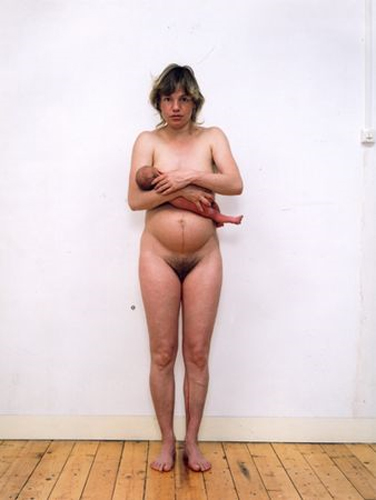
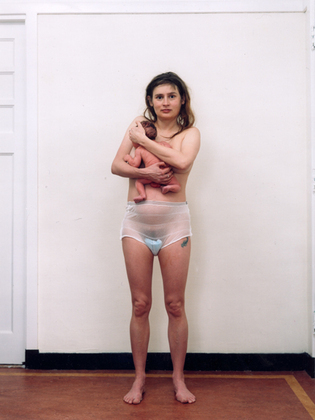
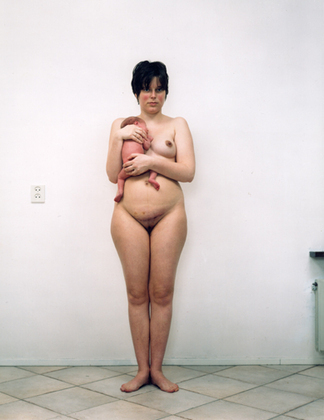
Anyway, she has some photos of post-birth mothers. They're large, almost life-sized. The women are completely nude and photographed holding their newborns. Here are some of them.

Tecla, Amsterdam, Netherlands, May 16, 1994

Julie, Den Haag, Netherlands, February 29, 1994

Saskia, Harderwijk, Netherlands, March 16, 1994

Pretty powerful stuff. My first thought was why are they standing up? Shouldn't they be relaxing somewhere, not having their portrait taken for my viewing pleasure?

The answer is in the clogs. The Netherlands has the highest homebirth rate in the world (30%), and only 10% of births make use of pain medication. If the birth takes place in a hospital, mothers are usually sent home within the day – with a kraamzorg, which is basically a post-partum doula who stays with the family for at least a week and is not, apparently, a cult favorite Star Trek character. You know, just to help out and all. According to my midwife, Dutch mothers don't express worries or fear about the birth experience, at least not at their prenatal visits. Birth is seen as a normal, healthy part of life.

I don't need to outline the contrast of America for you. We are so scared of birth. We have little support before, during, and after. We don't really have much contact with it until we're doing it ourselves, but we all know the script: the sports coach doctor shouts at you to push and you scream in agony until you beg for meds and the archangel doctor gives them to you, you weak, crazy woman.

 Like our idea of the travail of birth, beliefs about appropriate activity levels after birth are also culturally constructed. In Birth: The Surprising History of How We Are Born, Tina Cassidy writes about the old American/British idea that women should take to their beds for two weeks after birth, a recommendation that's been steadily shortened over the last 50 years to a two-day hospital stay (coinciding with the re-entrance of women into the workforce, hello capitalism).

So I guess this is why the women in Dijkstra's photos are standing. Unlike American mothers, who have been through hell and understandably need a little break, these Dutch mamas have been through a birth experience. Even Tecla, who has blood dripping down her leg, and Saskia, who's just had a C-section. And guess what? Women who are more active after birth have a lowered risk of blood clots.

Nobody should be getting up to run a marathon after birth. Birth is exhausting. But the constant depiction of post-birth American mothers as depleted invalids is part and parcel of our idea that birth is the worst thing ever. Frightening. Gross. A medical event to be performed under a bright light, legs in stirrups on a hospital bed.

Mother's Day: What I get out of it.

We talk a lot about sacrifice as it relates to motherhood. Mamas sacrifice their independence, their careers, their bodies, their personal goals, their marriages, their hairstyles... Pretty much anything you can think of to sacrifice, sometime, somewhere, a mama's done that for the sake of her child. I think we talk about this a lot because, a) mothers do make these sacrifices, and it's kind of amazing in an absurdist sort of way, and b) we're feeling a bit guilty because we don't really appreciate our moms, or motherhood, on a daily basis. So we have to idealize it and talk about its extremes.

But today, on Mother's Day, that most brunchy of holidays that doesn't rank high enough for a day off work, I'm going to write about what I love about being a mother. Not what I give it (that's for the other 364 days a year), but what it gives me.

Brunchy brunch-brunch brunch.
Women Laughing Alone With Salads (stockphotos at their worst best)


Meaning ~ 
I've always thought that children are the most precious things in the world. Precious and vulnerable. Raising children with love and respect is the most important thing. So, whammo! have a baby and never a day is wasted. Every day that passes in which I haven't maimed or traumatized our child, I'm helping him grow into a full-fledged person. Even on days that I can't get started, days when I'm *ahem* still sitting in my pyjamas and a milk-stained tank-top with a damp, milk-stained cloth diaper shoved down its front at 12pm. Life has meaning. This hang-nail, a direct result of not having time to maintain my appearance due to being a full-time mama? It has meaning, too.

Our new cloth-diaper-nursing-pad look, direct from Milan.


Company ~
It's hard to feel lonely with Sweet Baby James around. Sometimes I manage it anyway, but usually he's my pal who knows me (and my bathroom habits) like no one else (if you just clicked on that link, you are a disgusting, disgusting person. Just kidding!). The day before I found out I was pregnant I had just come back from a road trip. My new fiancé(!)* was still on the road. I spent the day alone, eating food from the freezer, unpacking, and soaking in the bath. I took a long walk up Mount Royal to see the season change into summer. I didn't talk to anyone. It was kind of blissful, but it was the end of an era. I haven't spent a day alone since. Spending them with someone who can't insult you and who wants nothing more than to entice you into a game of 'white plastic coat hangers look funny as a hat' is pretty darn nice.

*Ha ha ha, remember when Z was still my fiancé? No - you blinked? You missed it? Lolz.


Caretaking ~
I've always loved looking after people. This is not usually very healthy from a psychological point of view. I know, because my other job is therapist (which is kind of like being paid to look after other people). But anyway, having SBJ has been wonderful in this regard because I finally have someone into whom it's healthy and expected that I put almost all my energy. My friendships have suffered because mothering was pretty much the only way I related to people before (bossy, strict, nosey). But those dress rehearsals prepared me well for my onstage debut.

This is what never happens.


Movement ~
Becoming a mom has really changed my perception of my body. Yes, I would still like to be 10  (or 15, or 25...) pounds lighter, except that not really -- because then I couldn't carry my 30 lb. baby and I couldn't nurse him without body fat. As soon as I conceived, my body wasn't just something to be looked at and/or worked to the bone, it had a purpose. And it still does. Being a mother requires wrestling your son away from his self-appointed position as kitchen garbage inspector. Being a mother requires muscle.


For all these reasons and more, I feel blessed to be a mother. Happy mother's day!

(Grand)Mother's Day

Mother's day is the one day of the year that is set aside to honour - moms. Its the time every year when kids get their most creative, composing only the best most colourful macaroni necklaces, cards and flower pots. Its arguably the most busy day of the year because well - everyone has a mom, right? Wrong.

Sure everyone has someone who has given birth to them in order for their very existence, but does that make a mom, a mom? What about those kids that don't have a designated mom? Ones that were abandoned, or don't even have homes? Who do they celebrate? Or what about those kids that have grown up in the system because their own biological mother was unfit to properly care for them? Or those siblings that raise their younger brothers and sisters? Who do they give their macaroni necklaces to? 

Every year when mother's day rolls around I grapple with this issue. Mostly because I don't have a mom in the sense of what "mom" should be defined as. I fall into the category that covers the last two questions in the above paragraph. 

What I do have however, is a Grandma. Although I did not spend a lot of time living with her, she has always remained the one stable point in my life. It doesn't matter what time I call her, she's happy to hear my voice. She's encouraging, wise, kind and most of all strong. She took on the role of a parent for her grandchild - something that is not easy to do. She took me in when I needed a home. She clothed me, fed me, encouraged me to play sports and encouraged me in school. When I was sent home for housing a piercing business in the public washroom at school, got kicked out of k-mart for holding shopping cart races through the aisles and when the police came to her door when I punched a boy and broke his skateboard for calling my friend "fat" in elementary school - she didn't raise a hand to me. Not once. I never lived in fear. She dolled out consequences with a level head that were appropriate for the ridiculous thing I had done. 

I was a spirited child with a crazy imagination but she always went with it. She never once caused me to question my self worth because she accepted me. It wasn't until I lived with her that I realized that a mom, is not simply the person who gives birth to you. It is the person who waits up for you and worries when you are 5 minutes late for curfew - the person who cares enough to give you a curfew, the person who is there when you need a shoulder, the person who is always interested in what you are doing and what you have to say, the person that encourages you to become a reporter by allowing herself to be subjected to "interviews" every day for two months - but most of all, it is the person who accepts and loves you for who you are and the person you will become and is proud of you. 

There are many children that have grown up with the same relationship to their Grandmother, but I could never understand why it seems so difficult to find cards and items geared towards these special women for Mother's day. I am a firm believer that the special people in our lives should be celebrated every day, rather than one day a year. However it would be nice to have some representation in the Mother's day market for Grandmothers and other caregivers who deserve recognition. 

It was not until I had my own children that I became aware of the concept of what a mom could be. In my own life I feel fortunate to have such a wonderful family of my own with children that show me every day in their own way that I am appreciated. While they made me a wonderful breakfast in bed, and adorned me with their cards, homemade teeshirts, and the new wicker basket for the front of my bike, I couldn't help reflecting this morning. Reflecting on how truly lucky and appreciative I am. My children have made me a better person. They have taught me the art of patience, what it means to take pleasure in what we as adults take for granted (like making our hair stick up with balloons, carpet skates and parachuting with bedsheets), they have shown me that love has no boundaries, rather it grows every day - into something I never thought could be so powerful.

All of this has been made possible for me through the love, support and guidance (even if from far) of my Grandma. She has helped me in so many ways to realize and become the woman I am today. Her unconditional love and example has allowed me to have a normal parenting base to model some of my own parenting decisions. Something I might not otherwise have gained in other foster homes.


(Wedding day makeup with Gram looking on)

So like every Mother's day before today and all those to follow - I give my macaroni necklace to Grandma. 


I am so sick of talking about...

This.

Oh, and hearing about it too.


Did you know that the mother on the cover has received death threats?
As someone said on fb, it's only in America that murder is more appropriate than mothering.

Also, it is my birthday. I'm 26, again.

The Etiquette of Babywearing

Some thoughts on how to babywear, and how to do it nicely.


1. Courtesy:
If you see a mama on transit and she's wearing her baby, offer her your seat. It's like she's pregnant, but on the outside. If you see a papa on transit and he's wearing his baby... same thing.

Too Hot For Stroller!
2. Superiority:
No babywearing method is better than any other. You might have one you like. This doesn't mean it's OK to tell an exhausted parent that their forward-facing carrier is harming their child. Have you ever tried one of those things on? Baby will be out of that carrier in two hours, max. I promise. Bouncing baby boy will survive the bouncing baby Björn.


3. Gender:
Men wearing babies is sexy. I get it. That doesn't mean you can follow my husband around with drool hanging out the side of your mouth. No, he doesn't do it just to turn you on. And no, he doesn't need to provide a free therapy session to you about your unsupportive ex and your breastfeeding and feminist birth practices. He saves all the good stuff for me, bitches.
On a similar note, I don't appreciate leering comments about how, "I wish I could be carried around like that," or "I'll have what the babie's having." No, sir, you won't.


4. Sharing:
If you borrow a friend's carrier, return it in the same condition. In the completely hypothetical scenario that it's become coated in a funky-smelling fluid, hand wash it in water without soap. Hang it to dry. Anything else will compromise the carrier's fabric. If you're two people sharing a carrier (like, say, a husband who's 6'2" and a wife who's... not), your partner has every right to adjust it to their measurements.

5. R-E-S-P-E-C-T:
When babies are being carried they go into the 'quiet-alert state'. This is the best mental state for learning, and it's also the most passive. If you greet a baby and she responds with a blank face, don't take it as a cue to shout louder. She's not deaf, she's ignoring you. She's not ignoring you by accident, she's ignoring you because it's good for her.

6. Sleeping, part I:
Is that baby sleeping? Don't touch it. DO NOT TOUCH IT DO NOT TOUCH IT DO NOT TOUCH IT.

7. Sleeping, part II:
Is that baby sleeping? Don't expect his mama to stop and chat with you. She has better things to do, like go to the bathroom without being stared at from less than a foot away.


8. Carrier Making:
Kamika, of Oh Sew Serendipitous, weight-tests her fabric
at over 35 pounds for hours on end, and you should too.
This could be a post all to itself. Don't steal someone else's carrier design. Don't sew carriers that can't hold up to 30 pounds (yes, some babies are 30 pounds before their first birthday, no they are not all bottle-fed infants in Idaho), or if you do, make sure it's clearly labeled. Use good fabric and good construction: if you wouldn't carry your baby in that thing, why should someone else?


9. DO NOT TOUCH IT (again):
Lots of parents use carriers because they don't want strangers trying to pick up their babies. Don't be that person they complain about at the La Leche League meeting.

10. Nipple Confusion:
Babies can be nursed while they're in carriers. You might see a nipple if you're hanging out with a babywearing mama. The nipple might even have milk coming out of it. That milk might even be spraying around like a garden hose turned up full force. Deal with it. It doesn't mean you have to look the other way, stop talking to her, or that she needs to hide in a dark corner (she is not a teenage couple at a makeout party). If mama was uncomfortable with you seeing her nurse, she would make sure you didn't.


11. Development:
Babies carried develop at the same or faster pace than babies who are not. Comments like, "I'm surprised she can walk, you carry her all the time!" or "It's going to give him a twisted spine!" aren't just silly, they're offensive. And ignorant. And rude. And... ugh.


12. Cultural Appropriation:
My father showing us how to use the cradleboard he made
and in which he once carried me. Cradleboards
are used by indigenous people in North America
(including the Iroquios, Panobscot, and Navajo) as well
as the Saami (once called Laplanders) in Northern Europe.
We all know babywearing has been done in some form at some point of time in almost all 'traditional' societies. But which society does the kind of babywearing that you do? What do they call it? Show some respect and know the history of your carrier. And for goodness sake, don't buy a carrier with a racist name ('The New Native', 'papoose', etc.) and don't pretend it makes you some kind of 'authentic' something. There is no such thing as an 'authentic' anything.

13. Baby carriers count as clothes, part I:
A baby in a diaper in a baby carrier is fully dressed.

14. Baby carriers count as clothes, part II:
A mama in pyjamas with a baby in a diaper in a baby carrier is fully dressed.

15. Safety:
If you know something about babywearing and you see a baby being carried in a seriously unsafe way, by all means go up to the parent/caregiver and politely tell them what you see. Bear in mind that many carries look uncomfortable and downright precarious from the outside; only the person wearing the baby can feel where the baby's centre of gravity is, and that, for example, baby can lift her head on her own, and won't suffocate from resting it on mama's boobs. Mama's boobs are the best pillows.

B and BB

Beyoncé has long been a reverse eponym for fabulousness.
Now she's a breastfeeding, babywearing mama to (thigh-high) boot.

Check out more Too Hot For Stroller babaliciousness.


The Tuesday Photo: One year + Three weeks

Suddenly, my baby is a year and three weeks old. Also suddenly, he speaks French.

I chronicle these events on the Tuesday Photo but if you're pressed for time, you can just watch this video:

Sleep

Sleep.

At once both familiar and foreign.
Where there is a lack,
There is at once longing.

I long for sleep.

Long for the intimate moment in which we become one,
Dancing a dance of star crossed lovers that drift away on moments of surreal nothingness
Partaking in the embrace of darkness and peaceful breathing,

But alas, I sit here.

Yearning to experience restful slumber.
Until that time in which I am afforded your favor,
I will wait.

I will sit patiently, though not quietly,
For noise generated by my busy restless thoughts continues to hum through my mind,
Like a back up generator.
Thoughts that speak of deadlines, stresses, new project, ideas and day old dishes.

Still, I will wait.

I will wait tiredly as I listen to the whispers of enchantment a silent house brings,
Wait patiently for the moment when you will arrive, to make your move,
For it is inevitable that you will come to visit sometime soon.

You an I have a rendezvous.