


Goat Cheese and Roasted Beet Salad
A couple weeks ago we were invited to a potluck-family-get-together-reunion-thing. I love potlucks- but I hate cooking for them. Not because it requires cooking -I've always loved cooking and food. I love these elements because they bring people together regardless of language, age, beliefs, etc. Also, for me food is akin to art. What you create can reflect many things about you. But potlucks? That opens you up to a whole new dimension of pressure.
So as we were going over ideas of what we might bring when my husband ever so innocently suggested we bring coleslaw - I had to kindly (with minimal scoffing) shut him down. "What? Coleslaw? I have standards!" Besides, amongst 40 people you know that the potato salad, macaroni salad and coleslaw will most likely be covered by other people. I couldn't bring coleslaw, it was a matter of pride. No, for this event we needed something different and unique but not too out there that no one would want to try it (as I previously discovered most people have a comfort food zone and things like, say, vegetarian chickpea curry dip rest on the outer limits of this boundary).
After much humming and ha-ing we decided on a salad, since it was a BBQ type affair. After looking through different salads finally decided on a version of FoodNetwork chef Giada De Laurentiis' Beet and Goat Cheese Arugula Salad.
I pretty much followed the recipe (which is a rarity for me), the minor exception I made was that I made a balsamic reduction rather than just whisking together the ingredients for the dressing. Which turned out fabulous because it both thickened and sweetened the dressing adding more flavour and a warmth that just can't be topped when combined with anything goat cheese. Mmm I love goat cheese....
What I especially like about this recipe is that it adds the right amount of healthy with just a touch of naughty to satiate ones taste for indulgence.
Now enough small talk - on to the recipe!
You will need:
For Dressing:
First and foremost (and the longest part of this entire she-bang) is the beets. Select the ones you want to cook - I made the entire bag and jarred the remaining ones. Put them in a pot (skins on) with just enough water to cover them. Bring to a boil and cook for about 45 minutes- they should be tender enough to poke a fork through.

What most recipes don't tell you is that beets are messy business. Once you have cooked your beets, strain out the water and keep them in the strainer in the sink. This is where your gloves come in. To avoid looking like you have partaken in a crime scene, use the gloves to peel off the outer skins of the beets. With a little cold water they should just slide off easily. Be careful not to get the beet juice anywhere because it stains - and if your house is like mine (built in the 80's with horrid kitchen/decor choices) it will never come out of your white - yes white- counters.
Once you have them peeled cut them and set them aside to cool further. In the meantime start the dressing.

Balsamic reduction is just a fancy way of saying heat up your balsamic vinegar and simmer until it reduces, thickening as it does so. Once this happens whisk in the oil, honey, shallots and cumin.
Once finished put cooked beets and enough dressing to coat the beets in a bowl and toss to coat. Lay beets on a cooking sheet and toss them in a preheated oven (375 degrees). Let caramelize in the oven for about 20 minutes.
While the beets are cooking, toss together the diced avocado, arugula, walnuts and cranberries in a bowl.
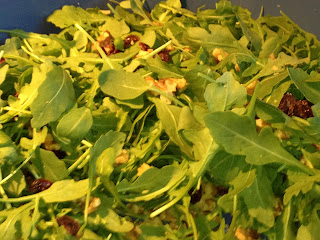
Once the beets are done caramelizing, remove from oven and let cool. Once cooled toss them into the salad. Add the dressing and crumble the goat cheese over top of the whole affair and you get this:

So as we were going over ideas of what we might bring when my husband ever so innocently suggested we bring coleslaw - I had to kindly (with minimal scoffing) shut him down. "What? Coleslaw? I have standards!" Besides, amongst 40 people you know that the potato salad, macaroni salad and coleslaw will most likely be covered by other people. I couldn't bring coleslaw, it was a matter of pride. No, for this event we needed something different and unique but not too out there that no one would want to try it (as I previously discovered most people have a comfort food zone and things like, say, vegetarian chickpea curry dip rest on the outer limits of this boundary).
After much humming and ha-ing we decided on a salad, since it was a BBQ type affair. After looking through different salads finally decided on a version of FoodNetwork chef Giada De Laurentiis' Beet and Goat Cheese Arugula Salad.
I pretty much followed the recipe (which is a rarity for me), the minor exception I made was that I made a balsamic reduction rather than just whisking together the ingredients for the dressing. Which turned out fabulous because it both thickened and sweetened the dressing adding more flavour and a warmth that just can't be topped when combined with anything goat cheese. Mmm I love goat cheese....
What I especially like about this recipe is that it adds the right amount of healthy with just a touch of naughty to satiate ones taste for indulgence.
Now enough small talk - on to the recipe!
You will need:
For Dressing:
- 1/4 cup balsamic vinegar
- 3 tablespoons shallots, thinly slice
- 1 tablespoon honey
- 1/3 cup extra-virgin olive oil
Salad Ingredients:
- 6 medium beets, cooked and quartered (get a pair of nitrile gloves for this step)
- 6 cups fresh arugula
- 1/2 cup walnuts, toasted, coarsely chopped
- 1/4 cup dried cranberries or dried cherries
- 1/2 avocado, peeled, pitted, and cubed
- 3 ounces unripened goat cheese, coarsely crumbled
First and foremost (and the longest part of this entire she-bang) is the beets. Select the ones you want to cook - I made the entire bag and jarred the remaining ones. Put them in a pot (skins on) with just enough water to cover them. Bring to a boil and cook for about 45 minutes- they should be tender enough to poke a fork through.

What most recipes don't tell you is that beets are messy business. Once you have cooked your beets, strain out the water and keep them in the strainer in the sink. This is where your gloves come in. To avoid looking like you have partaken in a crime scene, use the gloves to peel off the outer skins of the beets. With a little cold water they should just slide off easily. Be careful not to get the beet juice anywhere because it stains - and if your house is like mine (built in the 80's with horrid kitchen/decor choices) it will never come out of your white - yes white- counters.
Once you have them peeled cut them and set them aside to cool further. In the meantime start the dressing.

Balsamic reduction is just a fancy way of saying heat up your balsamic vinegar and simmer until it reduces, thickening as it does so. Once this happens whisk in the oil, honey, shallots and cumin.
Once finished put cooked beets and enough dressing to coat the beets in a bowl and toss to coat. Lay beets on a cooking sheet and toss them in a preheated oven (375 degrees). Let caramelize in the oven for about 20 minutes.
While the beets are cooking, toss together the diced avocado, arugula, walnuts and cranberries in a bowl.

Once the beets are done caramelizing, remove from oven and let cool. Once cooled toss them into the salad. Add the dressing and crumble the goat cheese over top of the whole affair and you get this:

Awesomeness in a bowl aka a big bowl of awesome
The original recipe serves 4. However I doubled this recipe for use as a potluck item and the increase in ingredient quantities did not change the fabulousness of the recipe.
Also, generally when there is a dressing and foliage involved its best to wait until right before serving to put the dressing on. I can tell you that I was in a pinch and went ahead and put the dressing on before leaving my house. 3 hours later the salad was un-wilted and still tasted great. In fact it was a hit at the party!
A Day *Gasp* Alone?!
I can't believe it. Even as I sit here typing this I am incredulous, giddy with excitement even. After the morning rush of off to school and work which included but was not limited to - scrambling to dry white shirts, prying 2 sleepy children out of bed with the help of a mini funnel/megaphone wielding toddler man, making 3 lunches, a cold shower (someone always flushes the toilet or runs the water it never fails), 5 breakfasts with an overly eee-yat interested toddler turned boot hanging off my leg, brushing my hair while putting socks on to get out the door in time to drop 2 children to two different bus stops at two different times, 1 daycare excited toddler and a tired, haggard bear husband to the train - I'm home. Alone.
I'm not at work. For the whole day. There is no one in my house except my three very overweight cats, my mini wiener dog, J's rat and our fish. And me. I can't even remember the last time I had the entire house to myself.
Where do I begin? What shall I do? The possibilities are endless! Should I catch up on laundry? Do dishes? Or even *gasp* nap? Or maybe I'll check out what's happening in the daytime television world. Are Nicole and Brady and item again? Did Chloe get her baby back from Phillip? It's been so long.

I'm not at work. For the whole day. There is no one in my house except my three very overweight cats, my mini wiener dog, J's rat and our fish. And me. I can't even remember the last time I had the entire house to myself.
Where do I begin? What shall I do? The possibilities are endless! Should I catch up on laundry? Do dishes? Or even *gasp* nap? Or maybe I'll check out what's happening in the daytime television world. Are Nicole and Brady and item again? Did Chloe get her baby back from Phillip? It's been so long.

"Like sands through the hourglass - so are the days of our lives..."
It's amazing how quiet things are when the hustle and bustle of daily life just slows. It's like time stops. I can hear the tick of the ceiling fan - does it always tick like that? I never noticed before...
The thing I realized is, as parents we tend to become so wrapped up in what's happening with everyone else and making sure no one is parachuting off the roof everything is running smoothly that it becomes easy to forget ourselves. What it feels like to be alone in our own space. It's a weird feeling. Like I should be running to grab the hockey stick from P before he wacks the wall with it again, or be on high alert for the crayon mine on the way to the washroom in case I slip and fall on one or lose an ankle to a lego. I have to keep reminding myself that the legos and crayons were put away and they will stay away for the next 5 hours.
The truth is, I miss everyone in the quiet. I crave the chaos. I've become an addict. Yes I enjoy the peanut butter hugs right after I just put on my only white work shirt and am on my way out the door. If I didn't I wouldn't keep a shirt on standby every day for just that reason. I also enjoy the morning breakfast routine "she's sitting too close to me!" "Don't touch me" "uhhhh why does she always have to smile at me??" "Mommmy mommmy mommy mommy - waffle, waffle, here, here, mine." Maybe I'm a bit crazy but I find it almost comforting to an extent. Or maybe that's what parenthood does to you - turns you crazy....
Despite missing the chaos I feel like today will be a great experience into the unchartered territory of aloneness. I may get bored and start harassing the cats, or try out meditation again.
Actually, on second thought, I think I'll start by taking an un-interrupted bath - with the door open. From there the possibilities are endless....
How Do Dinosaurs Learn their Colours?
This is technically wordless Wednesday- a day late - with words.


So how do Dinosaurs learn their colours?

Well as you can see.....

Through careful observation and hands on practice using a systematic trial and error method. Of course, ones own books make the perfect practice space....
Homemade Tomato Ketchup
As I realized this summer by my 5 and a half foot tomato cherry plant - apparently I have a knack for tomato gardening. Which is awesome right?
Well, that's the thing, when your plants are doing so well and have entered into a love affair with the neighbourhood bees and monarchs the resulting tomato offspring are numerous.

Which leaves the dilemma of how to go about using all the tomatoes before they go bad. I mean, lets face it- there is only so much spaghetti sauce one can make (especially on limited time). One obvious use for tomatoes is ketchup. J and E absolutely love ketchup, however the high fructose corn syrup and high salt content in the commercialized brands can cause many health problems down the road. Some include: high blood pressure, stroke, stomach cancer yadda yadda. Many of us have heard of the risks associated with consuming products containing high fructose corn syrup.
But does this mean that if we allow our kids to eat ketchup they will all grow up to be overweight, cancer ridden, ADHD monsters with high blood pressure? No, not necessarily. The key is really just moderation.
Although ketchup is high on the list of things containing both too much salt and high fructose corn syrup (ingredients that are lurking in many other products), there are some good things about it. For example Lycopene. Lycopene is the pigment that gives tomatoes their colour - and is a crazy powerful anti-oxident whose secret concentrated superfood power can only be unleashed through the processing of the tomato.
So the question becomes - how can we harness the anti-oxident power of the tomato while ridding our ketchup of all the excess crap?
Otherwise known as the whole reason behind this post.
Well, answer is simple - HOMEMADE KETCHUP! Yes, that's right. I decided to make my own. The recipe is actually very simple.


Well, that's the thing, when your plants are doing so well and have entered into a love affair with the neighbourhood bees and monarchs the resulting tomato offspring are numerous.
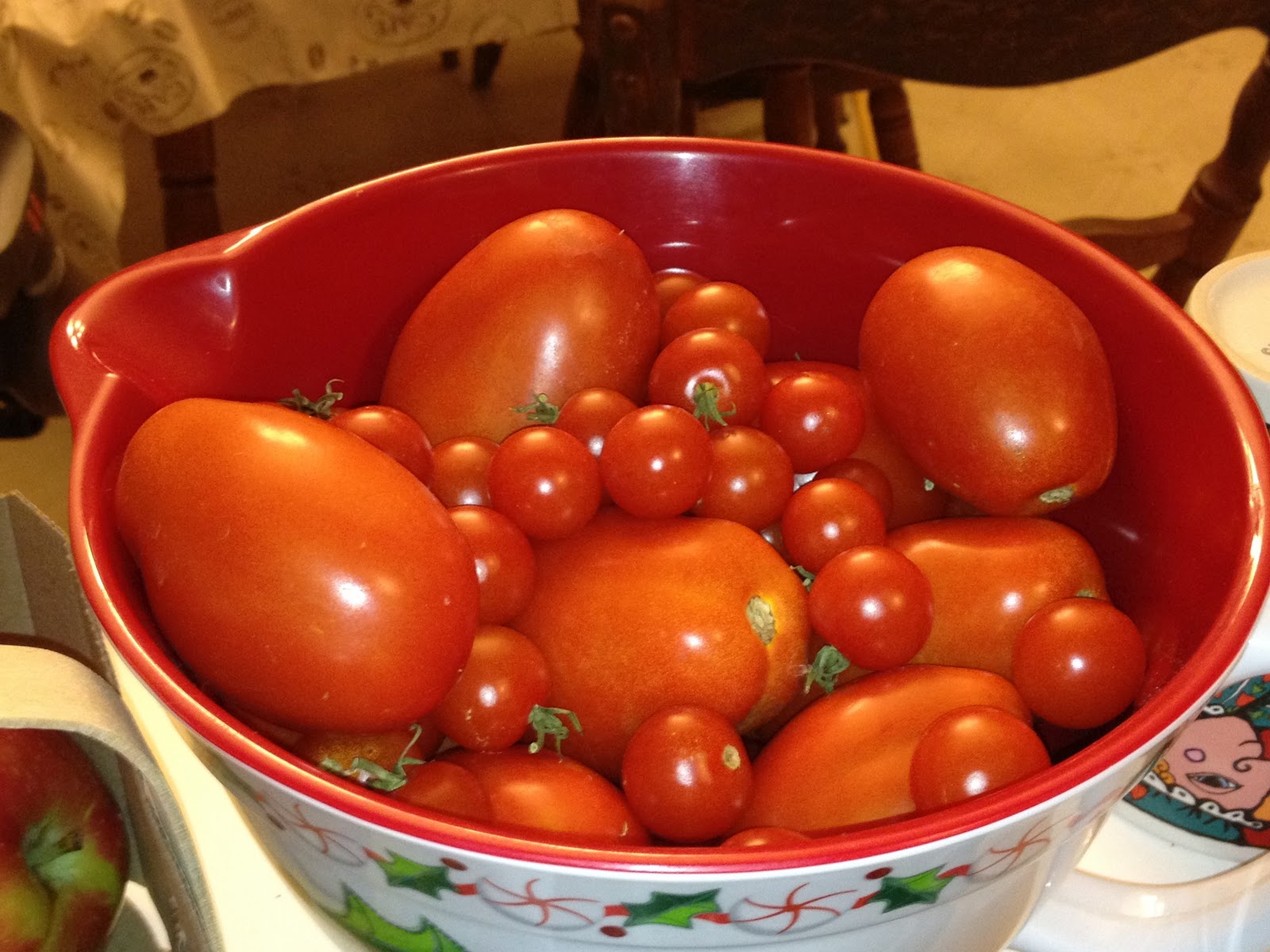
Which leaves the dilemma of how to go about using all the tomatoes before they go bad. I mean, lets face it- there is only so much spaghetti sauce one can make (especially on limited time). One obvious use for tomatoes is ketchup. J and E absolutely love ketchup, however the high fructose corn syrup and high salt content in the commercialized brands can cause many health problems down the road. Some include: high blood pressure, stroke, stomach cancer yadda yadda. Many of us have heard of the risks associated with consuming products containing high fructose corn syrup.
But does this mean that if we allow our kids to eat ketchup they will all grow up to be overweight, cancer ridden, ADHD monsters with high blood pressure? No, not necessarily. The key is really just moderation.
Although ketchup is high on the list of things containing both too much salt and high fructose corn syrup (ingredients that are lurking in many other products), there are some good things about it. For example Lycopene. Lycopene is the pigment that gives tomatoes their colour - and is a crazy powerful anti-oxident whose secret concentrated superfood power can only be unleashed through the processing of the tomato.
So the question becomes - how can we harness the anti-oxident power of the tomato while ridding our ketchup of all the excess crap?
Otherwise known as the whole reason behind this post.
Well, answer is simple - HOMEMADE KETCHUP! Yes, that's right. I decided to make my own. The recipe is actually very simple.
10 Tomatoes (I used Roma Tomatoes but you can use other kinds)
2 Yellow Onions
3 gloves minced garlic
1 small can tomato paste (or homemade from a ridiculous abundance of garden tomatoes....)
1/4 cup molasses
1/4 cup balsamic vinegar
1/2 tsp fennel seeds
2-3 tsp nutmeg
1/2 tsp allspice
1 Tbsp agave (you can find this in the organic section at most grocery stores)
***If you want to make a spicy version of this you can add a pinch of cayenne pepper

1. Process tomatoes and onions in food processor.
2. Add all other ingredients and blends together until desired consistency.

3. Put everything in a pot on the stove. Simmer on medium-low until mixture reduces by 1/4.

4. Cool and jar contents.
And Voila! Homemade ketchup - easy peezie lemon squeezie! Erm. Tomato squeezie? This recipe will thicken a bit more once its refrigerated but it remains a nice consistency. It has the triple stamped seal of approval from my three food critics - and I don't mind J and E slathering their food with it. So it's win win!
Nipples and Dinosaurs
As most of you probably haven't even noticed, I've taken a bit of a hiatus from posting. Here I return with yet another promise of updating more often. And to mark this momentous occasion and because I really need another project like I need another hole in the head - I've decided to make a quilt. Well, not for the blog, for P, but I'm going to document my journey to quilt hood right here.
Let me start off by saying- I have no idea what the hell I'm doing. However, I've always wanted to make a quilt so I decided to throw caution to the wind. It can't be that hard right?
I've decided to document the process for a couple reasons, but mainly forshits and giggles the sakes of archiving a process in which I have no idea what I'm doing, in order to reference at a later date, when I decide to undertake this project for J and E (if I ever actually finish it).
Since my last posting a lot has happened in the world of toddlerhood here at our house. P has started transitioning into a part time home daycare, which has been a big deal for all of us. Aside from the obvious reasons of myself and G being extremely over anxious at the thought of him being in someone else's care for a couple of hours a day- there is also the issue of him falling asleep without his Eee-yats (boobie snacks).
You see, I like my co-blogger Svea, am also a perverted masochistic extended breast-feeder with wrecked nipples who is raising a spoiled perverted child with rotten teeth. Or as I like to refer to it - a believer of self led weaning. As such, P is turning two very shortly and is still breastfeeding. At first, I was worried about how this might affect his transition into a daycare environment. This whole process got me to thinking of how I might be able to make the process easier for him - or more likely ease my over paranoid nerves into the process, as he seems to have adapted extremely well and has no need of my presence while he's there..... However, during nap time he does like to have a blanket in his hand to play with to help him fall asleep. Which is where the idea to actually buckled down and go about making a quilt came from.
I had to decide on what the theme of the quilt was going to be. I knew that I wanted to combine really soft materials with something he liked and an educational element. I came across some very soft minky fabric that is called "dimple dot." The dots were the perfect size nipples and since P loves to hang on to a nipple to fall asleep and I wouldn't be available for nap time, why not combine his two favorite things for the theme of the quilt? Nipples and Dinosaurs!
So I picked out a pattern that I'm going to tweak here. Found and purchased all the fabrics I felt would look good together, and essentially the idea will be to make this:
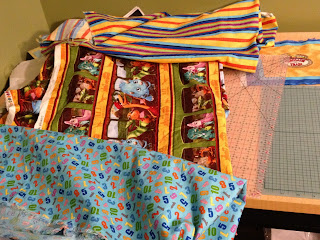


Into a quilt. Judging from what I've read it looks like alot of work. I'll be posting updates on a semi-weekly basis on the process. Wish me luck!
Let me start off by saying- I have no idea what the hell I'm doing. However, I've always wanted to make a quilt so I decided to throw caution to the wind. It can't be that hard right?
I've decided to document the process for a couple reasons, but mainly for
Since my last posting a lot has happened in the world of toddlerhood here at our house. P has started transitioning into a part time home daycare, which has been a big deal for all of us. Aside from the obvious reasons of myself and G being extremely over anxious at the thought of him being in someone else's care for a couple of hours a day- there is also the issue of him falling asleep without his Eee-yats (boobie snacks).
You see, I like my co-blogger Svea, am also a perverted masochistic extended breast-feeder with wrecked nipples who is raising a spoiled perverted child with rotten teeth. Or as I like to refer to it - a believer of self led weaning. As such, P is turning two very shortly and is still breastfeeding. At first, I was worried about how this might affect his transition into a daycare environment. This whole process got me to thinking of how I might be able to make the process easier for him - or more likely ease my over paranoid nerves into the process, as he seems to have adapted extremely well and has no need of my presence while he's there..... However, during nap time he does like to have a blanket in his hand to play with to help him fall asleep. Which is where the idea to actually buckled down and go about making a quilt came from.
I had to decide on what the theme of the quilt was going to be. I knew that I wanted to combine really soft materials with something he liked and an educational element. I came across some very soft minky fabric that is called "dimple dot." The dots were the perfect size nipples and since P loves to hang on to a nipple to fall asleep and I wouldn't be available for nap time, why not combine his two favorite things for the theme of the quilt? Nipples and Dinosaurs!
So I picked out a pattern that I'm going to tweak here. Found and purchased all the fabrics I felt would look good together, and essentially the idea will be to make this:
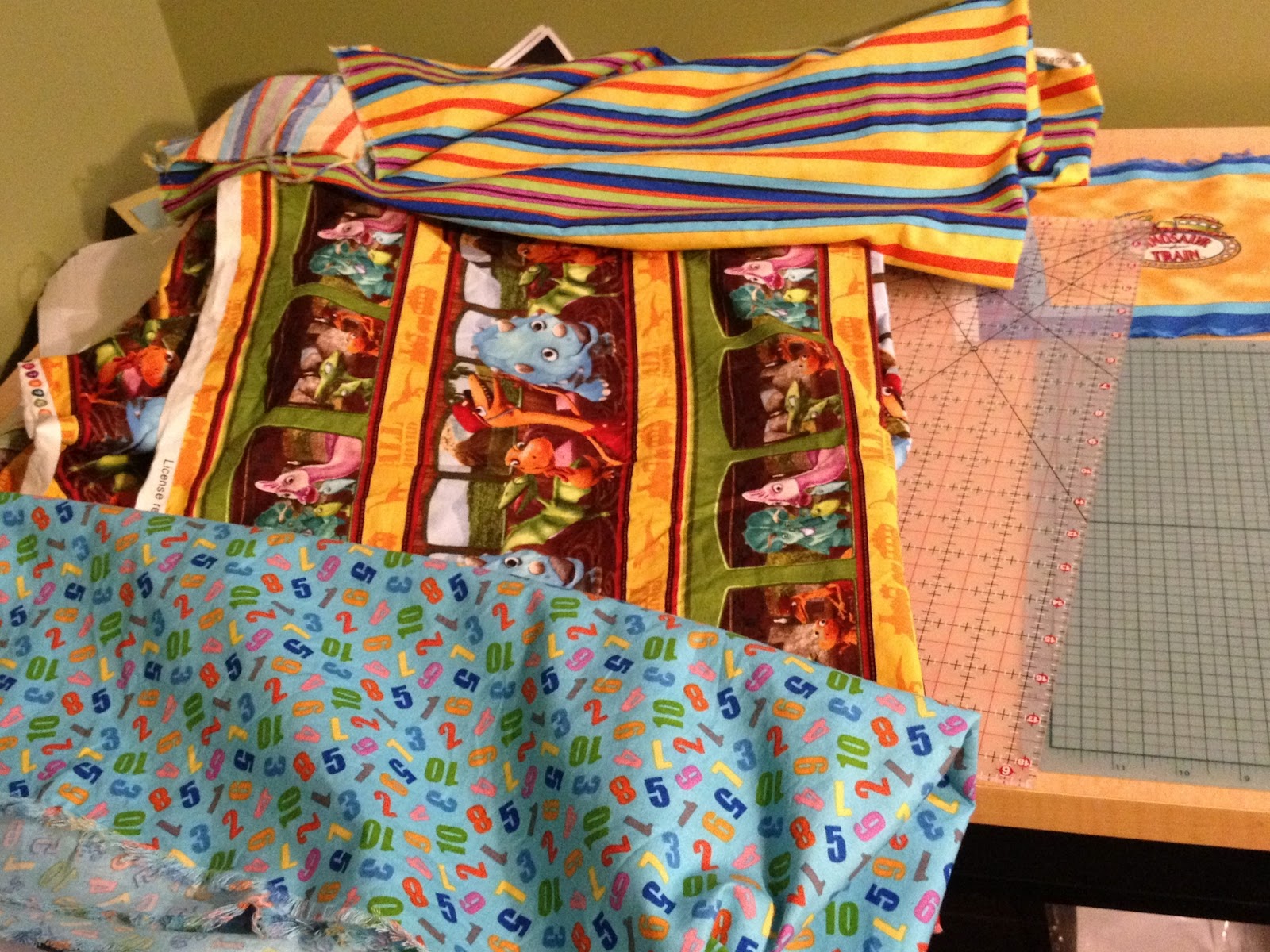


Into a quilt. Judging from what I've read it looks like alot of work. I'll be posting updates on a semi-weekly basis on the process. Wish me luck!
Loss of heritage
I generally use this space to talk about issues related to motherhood, rather than current events going on in the news at the present. However this issue, while not specifically related to the topic of children and motherhood, will in fact influence all of us -including our current generation of children.
I'm talking about the loss of heritage.
Have you ever had a school project related to history? Conducted your own research or written texts/books that require references to history? What about family history? When you listen to your favorite music on the radio-do you ever wonder what would happen if one day your favorite song ceased to be available? Do you ever wonder what would happen if all the documents, historical, personal or otherwise; the art objects, photographs, oral histories and even surgical instruments (yes surgical tools); music, documentation on grass roots movements, the feminist movement, and social justice literature were no longer available?
Well, we will soon find out. The following is an excerpt from the archival community's call to action that succinctly sums up current issues being faced by archives:
"On April 30, 2012, Library and Archives Canada (LAC) eliminated the
National Archival Development Program (NADP), a $1.7 million
contribution program administered for the LAC by the non-profit
Canadian Council of Archives (CCA) and distributed to 13 provincial
and territorial archives councils to support archival activities
locally. Through these councils, NADP funding is on the ground in our
10 provinces and 3 territories, ensuring that Canada’s history is
preserved in local communities. Canada’s archival councils provide
support to archives and archivists so that they may better serve all
Canadians.
The NADP was a vital component of LAC’s legislated responsibility to
foster preservation, promotion and access to Canada’s documentary
heritage. As stated in the Act:
7. The objects of the Library and Archives of Canada are…
(b) to make that heritage known to Canadians and to anyone with an
interest in Canada and to facilitate access to it;…
(f) to support the development of the library and archival communities.
8. (1) The Librarian and Archivist may do anything that is conducive
to the attainment of the objects of the Library and Archives of
Canada, including
(i) provide professional, technical and financial support to those
involved in the preservation and promotion of the documentary heritage
and in providing access to it;
The elimination of the NADP will result in the collapse of 11 of the
13 provincial and territorial archives councils, councils that support
the day-to-day functioning of archives across the country. Many of
these councils were forced to suspend operations immediately.
Archival institutions that invested precious resources into the
preparation of NADP funding applications were forced to suspend
projects that had already been approved by the CCA. Countless jobs
will now go unfilled. Consequently, archives’ mandate to make
government transparent, to make information available to citizens, and
to preserve records of Canadian culture and society will be greatly
diminished.
In addition, the federal government has sent more than 500 surplus
notices to Library and Archives Canada, which will ultimately have its
staff reduced by 20%. LAC has also cancelled its Inter-Library Loan
program; cut reference staff; imposed a "new service model" that
requires the public to make an appointment for reference requests; cut
library cataloguers by a third; and cut private archivists and media
specialists by 35%, which means not only that significant Canadian
heritage will not be acquired, but that researchers will not be able
to talk to experts who knew their fields as these experts simply won't
exist any more. At the same time, the government unilaterally shut
down libraries in the Transport, Immigration, and Public Works
departments."
Funding cuts to the Heritage sector and the cut of the NADP is not simply for the sake of budgets, but wreaks of a deliberate attack on heritage. Some might argue, a tactic to rewrite history in a militaristic light that kindly favors the current PM. This is not the first time Prime Minister Stephen Harper has attempted to rewrite history. Other examples can be found here. Why should this matter? Because archives and decisions made regarding them are important.
These decisions are important, because archival records will influence the future. What we choose to collect today, how we choose to describe those materials, and the messages that these actions will convey, will affect the knowledge and understanding of those histories for our unborn children, seven generations into the future.
So if droves of archival materials are being sold off at auctions and doors of archival institutions are being closed - who is left to preserve and make accessible these materials?
A common response to this is - well everything is digital now, so we don't need archivists or textual documents - wrong. Digitization is expensive. Not to mention it takes the specialization and staff of the very people whose jobs were or are in the process of being terminated as a result of these cuts. Not to mention preservation issues associated with born digital (items like word docs that never had a physical form) and digitized items are far from resolved. Sure you might have word documents now that are saved just fine on your computer - what will you do then in 5 years when the technology required to open or read these materials is obsolete? And who will be responsible for maintaining and preserving the digitized formats? Making them accessible to the public? Or ensuring their authenticity? Whether they are digital or textual, objects or photographs, someone is still required to ensure they survive as long as possible to carry forward to future generations.
The fact of the matter is, that archives touch facets of our daily lives that we are not even aware of and these cuts serve as a grave disservice to the Canadian public. They effect myself,
as a mother, archivist, art historian, postcolonial scholar, writer and activist. They effect the divorced woman who immigrated from Poland and needs historical proof of her marriage to her husband in order to be able to claim her pension - proof existing in the archives. They effect the scientists looking to refer to previous research in order to refine their own and contribute to advancements. They effect the student looking for answers to research questions or the child searching for information on their family tree for a school project. These cuts effect us all. Materials that are taught in elementary schools reference these archival materials, genealogy research requires archives.
While I'll be the first one to admit that history is most often written by the "winners" and that mainstream archival institutions themselves still have a way to go in terms of inclusion of traditionally marginalized communities - if they are no longer there, we will never be able to right social injustices. Library and Archives Canada has one of the most referenced record groups comprised of archival records of the Department of Indian Affairs (DIA). From its inception on April 15, 1755, the mandate of the DIA was to eliminate the culture of Aboriginal peoples by assimilating them into Euro-Canadian society. The
majorities of these records are kept at the National Archives of Canada (LAC)
and are referred to as records group 10 (RG 10). RG 10 is one of the most
referenced groups in the collection of LAC. Due to the control the DIA
maintained over all Aboriginal peoples of Canada, it is often referenced for
court cases, treaty claims and personal research. In recent news, in Toronto the United Church of Canada is in the process of finding archival evidence in cases of forced adoptions. So while archives, like history in general, are flawed in ways, they do serve as evidence. If you wipe out the evidence - who will be left to tell the story of our heritage?
Some of you might be sitting there reading this and saying, yes this is all fine and dandy, but what can I do about it? The answer is simple - everything. These programs and institutions are for the most part publicly funded. Which means we all have the ability and responsibility to make our voices heard. If you are interested in getting involved you can start by signing this petition and passing it on to everyone you know:
You can write a letter to your a Member of Parliment. Here is a list:
You can show your support by joining the Canadian Council for Archives Facebook group: https://www.facebook.com/pages/Canadian-Council-of-Archives-Conseil-canadien-des-archives/283674911724409
Lastly, join us on March 28th for the "On to Ottawa Trek." This is an event that will be culminating in Ottawa with regional activities cross-Canada. It is for everyone - not just archivists, students, historians, researchers, teachers, curators, writers or genealogists but anyone who cares about heritage and heritage preservation.
To find out about an event in your area you can refer to the official website:
We can not allow heritage to be lost. Let's stand up for heritage and ensure that
our unborn children, seven generations into the future will be able to benefit from a rich, diversified, inclusive, social history. (Grand)Mother's Day
Mother's day is the one day of the year that is set aside to honour - moms. Its the time every year when kids get their most creative, composing only the best most colourful macaroni necklaces, cards and flower pots. Its arguably the most busy day of the year because well - everyone has a mom, right? Wrong.

Sure everyone has someone who has given birth to them in order for their very existence, but does that make a mom, a mom? What about those kids that don't have a designated mom? Ones that were abandoned, or don't even have homes? Who do they celebrate? Or what about those kids that have grown up in the system because their own biological mother was unfit to properly care for them? Or those siblings that raise their younger brothers and sisters? Who do they give their macaroni necklaces to?
Every year when mother's day rolls around I grapple with this issue. Mostly because I don't have a mom in the sense of what "mom" should be defined as. I fall into the category that covers the last two questions in the above paragraph.
What I do have however, is a Grandma. Although I did not spend a lot of time living with her, she has always remained the one stable point in my life. It doesn't matter what time I call her, she's happy to hear my voice. She's encouraging, wise, kind and most of all strong. She took on the role of a parent for her grandchild - something that is not easy to do. She took me in when I needed a home. She clothed me, fed me, encouraged me to play sports and encouraged me in school. When I was sent home for housing a piercing business in the public washroom at school, got kicked out of k-mart for holding shopping cart races through the aisles and when the police came to her door when I punched a boy and broke his skateboard for calling my friend "fat" in elementary school - she didn't raise a hand to me. Not once. I never lived in fear. She dolled out consequences with a level head that were appropriate for the ridiculous thing I had done.
I was a spirited child with a crazy imagination but she always went with it. She never once caused me to question my self worth because she accepted me. It wasn't until I lived with her that I realized that a mom, is not simply the person who gives birth to you. It is the person who waits up for you and worries when you are 5 minutes late for curfew - the person who cares enough to give you a curfew, the person who is there when you need a shoulder, the person who is always interested in what you are doing and what you have to say, the person that encourages you to become a reporter by allowing herself to be subjected to "interviews" every day for two months - but most of all, it is the person who accepts and loves you for who you are and the person you will become and is proud of you.
There are many children that have grown up with the same relationship to their Grandmother, but I could never understand why it seems so difficult to find cards and items geared towards these special women for Mother's day. I am a firm believer that the special people in our lives should be celebrated every day, rather than one day a year. However it would be nice to have some representation in the Mother's day market for Grandmothers and other caregivers who deserve recognition.
It was not until I had my own children that I became aware of the concept of what a mom could be. In my own life I feel fortunate to have such a wonderful family of my own with children that show me every day in their own way that I am appreciated. While they made me a wonderful breakfast in bed, and adorned me with their cards, homemade teeshirts, and the new wicker basket for the front of my bike, I couldn't help reflecting this morning. Reflecting on how truly lucky and appreciative I am. My children have made me a better person. They have taught me the art of patience, what it means to take pleasure in what we as adults take for granted (like making our hair stick up with balloons, carpet skates and parachuting with bedsheets), they have shown me that love has no boundaries, rather it grows every day - into something I never thought could be so powerful.
All of this has been made possible for me through the love, support and guidance (even if from far) of my Grandma. She has helped me in so many ways to realize and become the woman I am today. Her unconditional love and example has allowed me to have a normal parenting base to model some of my own parenting decisions. Something I might not otherwise have gained in other foster homes.

(Wedding day makeup with Gram looking on)
So like every Mother's day before today and all those to follow - I give my macaroni necklace to Grandma.
Sleep
Sleep.
At once both familiar and foreign.
Where there is a lack,
There is at once longing.
I long for sleep.
Long for the intimate moment in which we become one,
Dancing a dance of star crossed lovers that drift away on moments of surreal nothingness
Partaking in the embrace of darkness and peaceful breathing,
But alas, I sit here.
Yearning to experience restful slumber.
Until that time in which I am afforded your favor,
I will wait.
I will sit patiently, though not quietly,
For noise generated by my busy restless thoughts continues to hum through my mind,
Like a back up generator.
Thoughts that speak of deadlines, stresses, new project, ideas and day old dishes.
Still, I will wait.
I will wait tiredly as I listen to the whispers of enchantment a silent house brings,
Wait patiently for the moment when you will arrive, to make your move,
For it is inevitable that you will come to visit sometime soon.
You an I have a rendezvous.
Mommy what is queer?
I have always encouraged my children from a very young age to ask as many questions as they like, about any topic that they are curious about. I believe these types of questions are important in fostering a child’s intellectual growth and allow them to gain awareness about how things work and their own surroundings. Over the years I have learned to be prepared for all and anything little inquiring minds may come up with in the form of questions – and I always do my best to answer as honestly and thoroughly as I know how.
Young children most always look to their parents for advice and knowledge when there is something they don’t understand. These questions can take many forms, some of my favorites include: why is the sky blue? If I take a screwdriver and unscrew my belly button will my butt fall off? Are boogers made out of brains?
The above questions are relatively easy to answer or find the answers to. This in my experience, is generally the scope and complexity of the questions presented by younger children. As they grow older, I am finding that the inquiries are becoming more complex. Whereas previously, my husband and I, or a trusted adult family member, served as valuable sources for reliable information, this is eminently changing. As they start to reach the age in which they are old enough to begin seeking out answers to life’s many mysteries from other information sources, answers may become conflated with inaccuracies and are in fact misinformation.
High school is the perfect breeding ground for many of these complex questions, the answers for which are being given by misinformed, (however well intentioned they may be) friends. Some of these friends may have parents that share the same parenting styles and beliefs that you do – others- not so much. Some of these friends may come from families that have strict religious beliefs on specific topics that govern their views on social issues that include topics such as race, politics and sexual orientation- others are simply misinformed, or just downright ignorant. The scary part about adults that hold specific views that are harsh or ignorant of the basic concept of human rights, is that these views transfer to their children, who then provide information to their friends. Children do not possess an innate concept of hate, racism or marginalization: this is something that is taught. By parents and other influential players throughout a child’s development.
Driving in the car yesterday, J turned to me and asked me point blank “Mommy, what does queer mean? Is it the same thing as gay? Some people at school say gay means happy but I hear other people saying that it means something different…”
Of all the years that I have been encouraging and answering questions from my children, I never considered that this might be a question. I took it for granted, and I was unprepared. I have made it a point to engage J in important dialog about various things such as the topic of sex, menstruation, racism, etc. but I had missed this topic entirely. How could this be?
I have many friends from the LGBT (lesbian, gay, bisexual and transgendered) community and always took for granted that even though I don't define my friends in terms of their race, religion, cultural background, gender or sexual orientation, that, high school tends to become an exercise in “people labeling.”
Sexual orientation of people was never something that occurred to me in terms of “normal” or “abnormal” the way I always understood it was love knows no gender. Faced with J’s question I was forced to consider what I knew of growing up, and realized: I never had any discussions about what it meant to be gay or queer, it just wasn’t discussed. Not like the birds and the bees, or menstruation. I found myself in an odd predicament. Although I have friends that self identify as LGBT, non of them are currently in a long term relationship, if in relationships at all, and non have children. As such, it was never a topic that came up – until now.
As a parent, I am aware of the impact certain moments and the way things are explained can have on my children. I am most certainly not perfect in any right, which is part of being human. It was really important for me to try to explain this to J in terms that she understood, without giving information that might be inaccurate. So where could I go? Well, I did some internet trolling, and came up with a couple of sites that might be of use to parents who might be looking for similar information.
The first one is from Berkeley’s Gender Equity Resource Center. The resource center offers a thesaurus of terms and their definitions. These terms range from “queer” and “Dominant culture” to “gender conformity” and “heterosexual” with everything in between. Some of the terms listed on that link are beyond the scope of the topic of discussion, but it offers a good base to start from.
Another useful link is PFLAG a non-profit org, best described by its mission statement:
“PFLAG promotes the health and well-being of lesbian, gay, bisexual and transgender persons, their families and friends through: support, to cope with an adverse society; education, to enlighten an ill-informed public; and advocacy, to end discrimination and to secure equal civil rights. Parents, Families and Friends of Lesbians and Gays provides opportunity for dialogue about sexual orientation and gender identity, and acts to create a society that is healthy and respectful of human diversity.” On this site there are many links to information and educational initiatives.
Parents will never have the answers to everything, but we do the best we can. The important thing I have found in my experience is to be open and willing to listen and answer questions to the best of my ability. Sometimes this means doing some extra digging around to find ways to explain things in age appropriate terms.
When it came down to my explanation I stuck with a combination of what I know, and offered up further information from the links above. This was best broken down into three important concepts:
1) Gay can mean more than one thing. It can mean happy. It can also be used in a situation where two people of the same sex either two boys or two girls are in a loving relationship. The same exact way that a boy and a girl can be in a loving relationship. It is also used by some people in a hurtful or mean way - this is wrong and those people need to be educated.
2) Queer is a more complicated term to explain. It is a term that is used to describe many people (an umbrella term). People who feel that people aren't born either a "boy" or a "girl" but that people can be either or. This could include people who are gay or people who are not gay. There is a whole area of study focused on this topic called queer theory.
3) There is nothing wrong with being queer or gay. People are people. Whether someone is queer or gay does not mean anything different. Its the same way that your name is J does not mean you are different, you are still a human being. Someone that does not know you cannot tell by looking at you, that your name is J any more than someone can tell by looking at a gay person that they are gay.
Unfortunately, in this day and age, people still need to be taught tolerance. I am a firm believer that our children are the key to a future of peace, tolerance and equity and that education offers a firm foundation for the way in which our children will act and respond to particular situations as adults.
Perhaps the most important lesson we can ever pass on to our children is that human rights are universal, and a natural right to all human beings regardless of race, religion, culture, economic status, or sexual orientation.
Everything you never wanted to know about lice
Welcome to my last two weeks.
I decided I was going to start back at the gym. Now that P is comfortable enough to spend an hour or two with Grandma and Grandpa a couple times a week, G and I thought it would be a great way to both spend time together and be productive health-wise.
All set up and ready to begin the first week and BAM. It hit. You know, that cold that has sort of been floating around the house in a non-threatning-not-sure-if-its-actually-a-cold-or-just-sinuses type of situation. Of course by the time it has gone through the whole family and finally gets to mommy and you realize it is a cold, it has mutated into some intense, overly-resistant version of what feels like a cross between being hit by a mac truck and drowning in a sea of mucus. That's the one I'm talking about. Not like you could take anything for it anyways if you were breastfeeding, other than ginger tea and some vitamin C *yeehaw*. Only thing to do is ride it out for the 14 or so days it takes to leave your system.
14 days that become extended because an overly active sleep-is-for-wimps 15 month old has decided he no longer needs sleep to fuel his body-and neither should you. Because what is more fun than watching the dog eat his kibble at 3am through peels of laughter because the crunchy sound doggy makes when he bites is hilarious?
Of course through the sickness and sleep deprivation there are an abundance of assignments due all on the same week -two per day of class. Assignments that won't write themselves because they don't take sick days.
Then. Just when you think you accept that your goal is going to have to wait and you've gotten the hang of surviving off of 15 minute naps during class and possibly a little to much half-caf, you arrive at your train stop and greeted by your lovely family - and LICE.
Yes - LICE. Apparently they wanted to join the party.
Now, lice is not the most appealing topic for a blog post, so if your squeamish, or feel like after reading about lice that your head is suddenly itchier than before reading about lice- stop here.
Anyone else that wants to know more - keep calm and carry on.
Lice is apparently really common in schools. Anyone that has kids has seen the letters home every now and then declaring there has been some spotted on another kids hair. Then breath a sigh of relief when your children pass the lice check.
What do you do if your kid gets it though? Its highly likely that it will happen when children are in elementary school. Although its not something we prepare ourselves for. What does it look like? How can you spot it? How do you get it? Who can get it? If your children contract it and the lice have started building lice colonies, making lice babies and building lice freeways through their hair, how do you take the fuckers them out?
This brought me to the point of todays post which is: everything you never wanted to know about lice (until your kids get it).
1) Lice is spread through close contact with people who have it. Which stinks if someone in your lice-free child's class has it unknowingly and comes to school. Lice are all about spreading the love. In fact, I have a sneaking suspicion their goal is to take over the world-one head at a time. If your in the situation where your child contracts lice, everyone in your household has to be checked. This does not mean everyone in your house will have it if one person has it.
2) You can get lice by sharing towels, bedding, clothing and brushes of someone who has it. We've been told many a time growing up "don't share hats or brushes," it was like one of the cardinal rules of childhood. The fact of the matter is though - kids naturally want to share things with their friends, they also have sleepovers sometimes- or in some cases- they forget their hat at school and decide to borrow their younger sisters hat and she has lice.
3) Symptoms of lice are , red bumps on back of the head and an intensely itchy scalp. The itching is not to be confused with dandruff though. People who have dandruff also have itchy scalps. The difference can be seen between the two upon examining the hair. General rule of thumb: if you blow on it and it flies off the hair, or if it flakes off the hair by moving strands - it's dandruff. If its small and white and looks like dandruff and you try to move it off and it sticks - it could be nits (lice eggs).
4) Lice do not jump. This is a myth. So while as you were reading this and your head started feeling itchier, rest assured that they do not jump from head to head. They much prefer to take public transit because they cannot survive long off humans.
5) Having lice sucks so badly because it can be hard to see and identify if you don't know what your looking for, making eradicating the bastards a nightmare.
Sometimes you need to use a magnifying glass. As I was unfortunate enough to find out - once you've seen one and you know what it looks like, you will never psychologically be able to go back to a pre-lice seeing state. Which makes identifying them easier. That being said, if you have never seen one, or don't know what you are looking for, I have provided the least extreme, non-magnified image of lice I could find to save you the horror of googling lice yourself- nothing good can come of viewing those images...

The best way to describe them is that they look sort of like sesame seeds. They are usually all along the strands of hair, and if they are live and you move the hair - you can see them moving.
6) Once treated, the dead eggs (nits) will still be stuck to the hair. Lice can be treated with an over the counter lice killing shampoo. You can get it by simply going to your nearest pharmacy and asking your pharmacist. They are more than able to help you as they get an abundance of parents in hysterics over lice on a fairly frequent basis. Once administering the treatment (which must be done twice because lice can live for 30 days on a human and their eggs for up to two weeks), the eggs will still be visible on the hair. This is because a special fine toothed comb must be used to take them off the hair because lice use crazy glue to make sure their eggs are properly attached to your child's hair. The best type of comb for this is the metal ones.
7) Applying olive oil to the hair helps remove the dead eggs. I just recently found this out after my 50th comb through two heads of long hair. I would've love to know this prior - so I'm paying it forward.
8) If someone contracts lice it doesn't mean they are un-hygenic. This is also a myth. Lice can strike anytime, anywhere. They mostly thrive in elementary school environments however, because schools are places that offer a lot of housing opportunities with potential to expand. Long story short- lice are assholes that take advantage of our children's innate kind nature of wanting to share their stuff with their friends.
Unfortunately once contracted it takes two treatments and a lot of picking through hair and brushing with a fine tooth comb to get them out. All the bedding and stuffed animals, hats or other things that the person who contracted it has come into contact, with should be burned.
I kid.
They only have to be washed in hot water and put in the dryer on high.
On the plus side, all those hours spent picking through hair has brought about ideas for lucrative projects. G's current suggestion of buying a few chimps and renting them out by the day with a nit-free-in-24-hours-or-your-money-back guarantee might be useful.....
Any takers?
Subscribe to:
Posts (Atom)